Church History
Gregory VII and the Cost of Purifying the Church
A look at the pope who pressed for reform, defended the freedom of the Church, and endured one of the great crises of medieval Christendom.
Site Admin | December 27, 2025 | 83 views
The world Gregory VII inherited
Pope Gregory VII history cannot be told apart from the troubled Church he inherited. He was elected pope in 1073, a moment when serious reform had already been underway for decades, but had not yet reached its full force. Many Catholics, clergy and laity alike, longed for a Church that would be more clearly ordered to the Gospel, less entangled in secular power, and more faithful in discipline.
The age was marked by deep confusion. Some bishops had been appointed through political influence rather than spiritual fitness. Clerical marriage and simony, the buying and selling of sacred office, had weakened Christian witness in many places. At the same time, rulers of the Holy Roman Empire and other powers often expected to shape Church life according to their own interests. The result was a painful tangle of spiritual and political authority.
Gregory VII, born Hildebrand, did not invent the reform movement, but he became one of its clearest and most determined voices. He had served the papacy for years before his election and knew the weaknesses of the system from within. His pontificate was not a detour from reform but an intensification of it, guided by a conviction that the Church must be free to carry out Christ's mission without being mastered by worldly ambition.
A reformer shaped by conviction and office
Gregory was not a detached theorist. He was a man of administrative experience, spiritual seriousness, and strong moral resolve. As pope, he saw his duty not as preserving comfort but as strengthening discipline and restoring order. The papal office, in his mind, was a service to the Church's holiness.
One of Gregory's central concerns was clerical reform. He pressed against simony and insisted that clergy live in a manner worthy of the sacred mysteries they celebrated. This was not a matter of mere institutional tidiness. For Gregory, the credibility of the Church's witness depended in part on the integrity of those who served at the altar. The Lord's words remain a searching standard: Let your light shine before others and Be holy in all your conduct.
He also championed the freedom of the Church from lay control in matters properly belonging to spiritual authority. That issue would become the center of the long and painful conflict known as the Investiture Controversy, in which bishops were often invested by rulers with symbols of office and expected to serve political rather than ecclesial interests. Gregory believed that the Church could not be faithfully governed if sacred office were treated as a tool of the state.
The struggle over investiture
The Investiture Controversy was not simply a legal quarrel. It was a test of who ultimately had the authority to appoint bishops and to define the relationship between spiritual and temporal power. Gregory VII insisted that the Church, while living in the world, does not belong to the world. Christ entrusted the apostles with a spiritual mission, and that mission could not be subordinated to the ambitions of princes.
This position placed Gregory on a collision course with Emperor Henry IV. The conflict escalated sharply after Gregory took disciplinary action and Henry resisted. Mutual accusations followed, and the crisis spread beyond court politics into the life of the Church across Europe. Many bishops found themselves caught between loyalty to the pope and pressure from the emperor. Ordinary Catholics, too, were drawn into a struggle they did not choose but could not ignore.
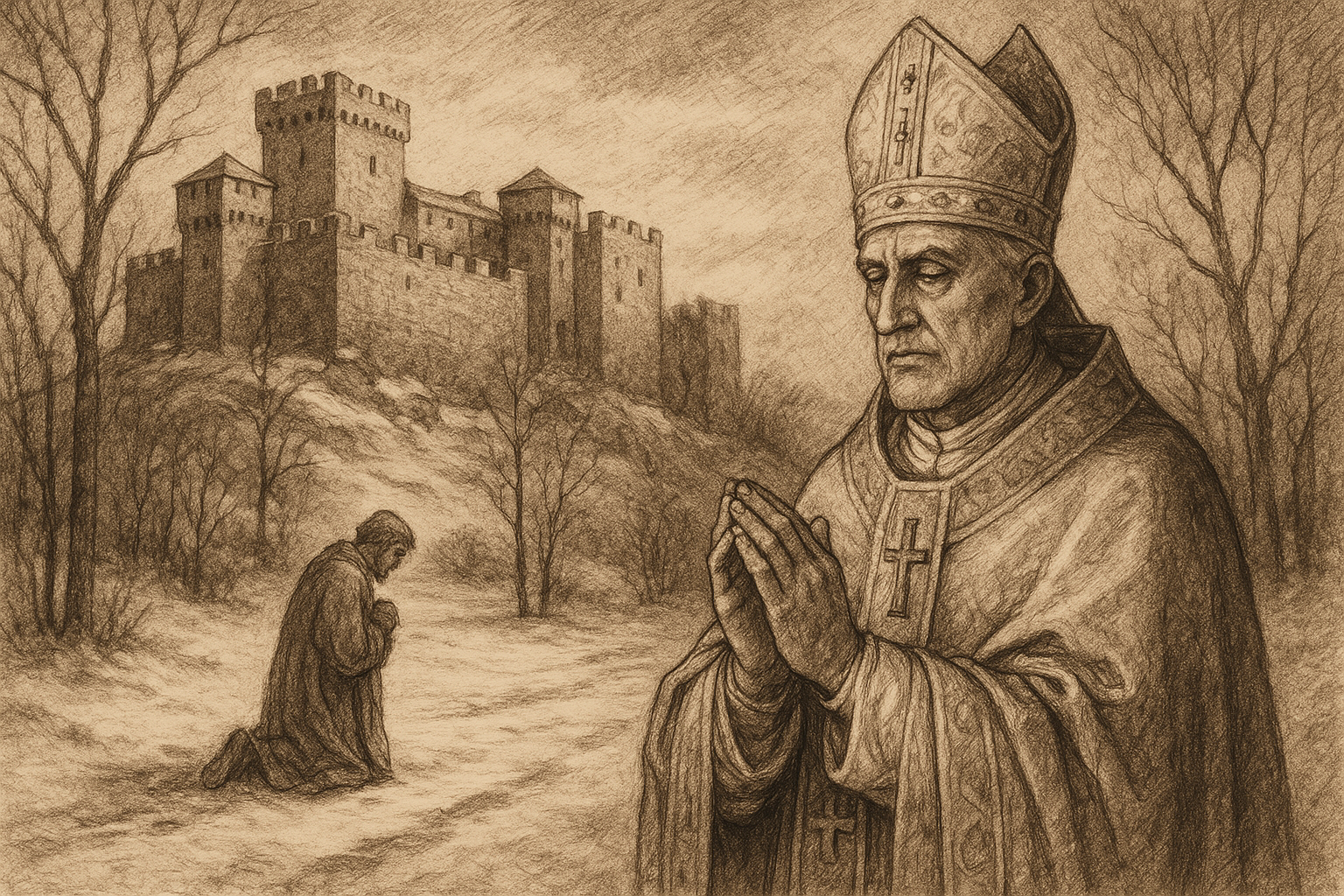
The dramatic episode at Canossa in 1077 became one of the best known moments of Gregory's pontificate. After excommunication and political turmoil, Henry IV sought reconciliation with the pope. The image of a ruler standing in penitence before the Church has often been remembered as a sign of papal strength, but its deeper meaning is spiritual. Gregory was not seeking personal triumph. He was defending the principle that no Christian, however powerful, stands above repentance or above the moral order of God.
True reform in the Church is never just about procedures. It is about turning back to God, honoring truth, and allowing grace to correct what pride has distorted.
What Gregory defended, and why it mattered
Gregory VII history is often reduced to conflict, but that misses the positive vision behind his actions. He wanted the Church to be able to preach, sanctify, and govern with integrity. He wanted clergy who would serve Christ rather than factions. He wanted bishops who would be shepherds, not political appointees seeking advantage. He wanted the pope to speak with moral authority because the office was ordered to the good of the whole Church.
His famous Dictatus Papae, a collection of propositions associated with his pontificate, reflects this strong understanding of papal authority. It is often discussed because of its bold claims, and those claims have generated debate for centuries. But in context, the work reveals Gregory's conviction that the papacy existed to safeguard the Church's unity and freedom. In a fractured world, he saw the successor of Peter as a necessary center of visible communion.
At the same time, Gregory's vision did not depend on personal charisma or worldly success. He knew the price of fidelity. His later years were marked by exile and suffering. He died away from Rome in 1085, with the conflict unresolved. His reported final words, often remembered in tradition, express the sadness of a man who believed he had loved justice and hated iniquity. Whether or not one dwells on the exact wording, the broad fact remains: Gregory did not enjoy an easy or triumphant end. He suffered for the reform he believed the Church needed.
The human cost of reform
It is easy to admire reform in theory. It is harder to carry it out when the work provokes backlash, misunderstanding, and isolation. Gregory VII faced all of these. He could be severe, and some of his decisions invite careful historical scrutiny. Catholics need not pretend that every aspect of his administration was uncomplicated. Yet even his harsh edges belong to a larger and sobering picture: the Church's renewal often moves through conflict because sin resists correction.
The New Testament does not promise that fidelity will be admired. Instead, it warns that those who seek to live and lead in truth may meet opposition. If the world hates you, know that it has hated me before it hated you and All who desire to live a godly life in Christ Jesus will be persecuted. Gregory's life illustrates this pattern on a historical scale. He was not a martyr in the strict sense, but he was a confessor in spirit, bearing cost for a principle he believed to be rooted in the Church's divine constitution.
His pontificate also reminds Catholics that reform is not a modern invention. The Church has repeatedly needed purification, not because Christ failed, but because her members do. Reform is part of the Church's life whenever holiness is taken seriously. Gregory VII belongs to that long history of correction, renewal, and difficult obedience.
What modern Catholics can take from Gregory VII
Modern Catholics do not live in the world of eleventh century emperors and bishops, but the basic tensions Gregory faced are still familiar. The Church can still be tempted to compromise with worldly power. Clergy can still be judged more by usefulness than holiness. Christians can still confuse influence with faithfulness. In that sense, Gregory remains surprisingly relevant.
First, he teaches that the Church must remain free for her mission. When the Church becomes captive to political fashion, financial pressure, or fear of controversy, she loses clarity. Gregory VII history shows that defending freedom for the Church is not about pride. It is about preserving the conditions under which the Gospel can be preached without distortion.
Second, he shows that reform begins with conviction. Real renewal requires leaders who believe that holiness matters more than comfort. Gregory did not think discipline was optional. He understood that external order serves internal fidelity. Catholics today can apply that insight in parish life, family life, and personal discipleship. The hidden work of repentance matters.
Third, Gregory's life warns against despair when reform is slow. He did not see the full fruit of his efforts. Yet history did not forget him. The conflicts of his reign helped clarify the distinction between spiritual and temporal authority, and later centuries built upon those hard lessons. Much of the Church's later freedom was protected by the sacrifices of those who fought before the victory was visible.
Finally, Gregory reminds Catholics that a strong defense of Church authority must always be joined to humility before God. Authority is not an end in itself. It is stewardship. Whenever the Church speaks with firmness, she must do so as a servant of Christ, not as a rival to Him. Gregory's era makes that point plain. The pope's task is not to replace the Lord, but to guard the flock entrusted to Peter.
For Catholics reading Gregory VII today, the lesson is not to imitate every tactic, but to admire the courage that refused to surrender the Church's freedom. He lived in a hard time and made hard choices. His witness still calls believers to seek reform without cynicism, fidelity without fear, and authority without compromise.
That is part of why Pope Gregory VII history remains more than a chapter in medieval politics. It is a reminder that the Church is continually being asked to choose whether she will belong to Christ in fact as well as in confession.
Keep Reading on Lets Read The Bible
Frequently Asked Questions
Who was Pope Gregory VII?
Pope Gregory VII, born Hildebrand, was pope from 1073 to 1085. He is remembered for pressing reform in the Church, opposing simony, defending clerical discipline, and resisting lay control over bishop appointments.
What was the Investiture Controversy?
The Investiture Controversy was the conflict over who had the authority to appoint bishops and invest them with symbols of office. Gregory VII insisted that spiritual authority belonged to the Church and could not be controlled by secular rulers.
Why is Pope Gregory VII important for Catholics today?
He shows that the Church must remain free to carry out her mission and that reform requires courage, discipline, and fidelity to Christ. His life also reminds Catholics that holiness and ecclesial freedom are closely connected.