Church History
St. Gregory the Great and the Art of Steady Faith in Unsteady Times
A closer look at the pope who served the Church with clarity, humility, and pastoral strength
Site Admin | December 24, 2025 | 81 views
St. Gregory the Great stands among the most influential figures in Catholic history because he did not treat crisis as a reason to retreat. He lived in a world marked by political instability, social distress, and the slow unraveling of Roman public life. Yet he answered the moment with prayer, discipline, and a steady concern for souls. That combination makes St. Gregory the Great Catholic history more than a chapter in the past. It remains a guide for Catholics who want to live faithfully when life feels uncertain.
Gregory was born around 540 into a noble Roman family and entered public life before becoming a monk. He later served as a papal representative and eventually as pope from 590 to 604. His age was not easy. Rome had suffered war, plague, poverty, and repeated instability. The old civic structures that once supported public order had weakened. In that setting, the pope often had to act not only as a spiritual shepherd but also as a practical organizer, comforter, and defender of the poor. Gregory accepted that burden without losing sight of the higher purpose of the Church: the salvation of souls.
A Pope Formed by Prayer and Responsibility
Gregory did not become a great pope by accident. Before his election, he embraced monastic life, and that habit of prayer shaped everything else he did. He understood that action without contemplation becomes noisy and shallow. At the same time, he did not imagine that prayer meant withdrawal from the needs of others. His life shows that Catholic leadership belongs to those who are rooted in God and attentive to reality.
This balance matters because the Church has always needed leaders who can see both the eternal and the immediate. Gregory wrote, preached, governed, and negotiated. He sent missionaries, supported reforms, cared for the poor, and worked to strengthen Church discipline. Yet his activity was not driven by ambition. It came from a deep sense of duty before God. Catholics today can learn from that posture: to do what is needed, but to do it from a heart trained by prayer.
The World Gregory Inherited
To appreciate his importance, it helps to remember the historical setting. Gregory became pope in a period when many people felt that the old world was coming apart. Rome itself no longer had the political weight it once enjoyed. The city was vulnerable, and the people were often burdened by famine, war, and disease. In such conditions, ordinary people needed more than distant principles. They needed shepherds who could speak with authority, organize relief, and keep the faith visible in daily life.
Gregory did not romanticize the situation. He knew the fragility of earthly power. He also knew that when human systems grow weak, the Church's task becomes more visible, not less. The pope's role as a servant of unity and a guardian of doctrine was tested by the needs of a battered people. Gregory met that test with realism and trust. He neither collapsed into despair nor pretended that problems would solve themselves.
Gregory's age reminds Catholics that faith does not depend on favorable conditions. The Church often shines most clearly when the world is least stable.
What He Did for the Church
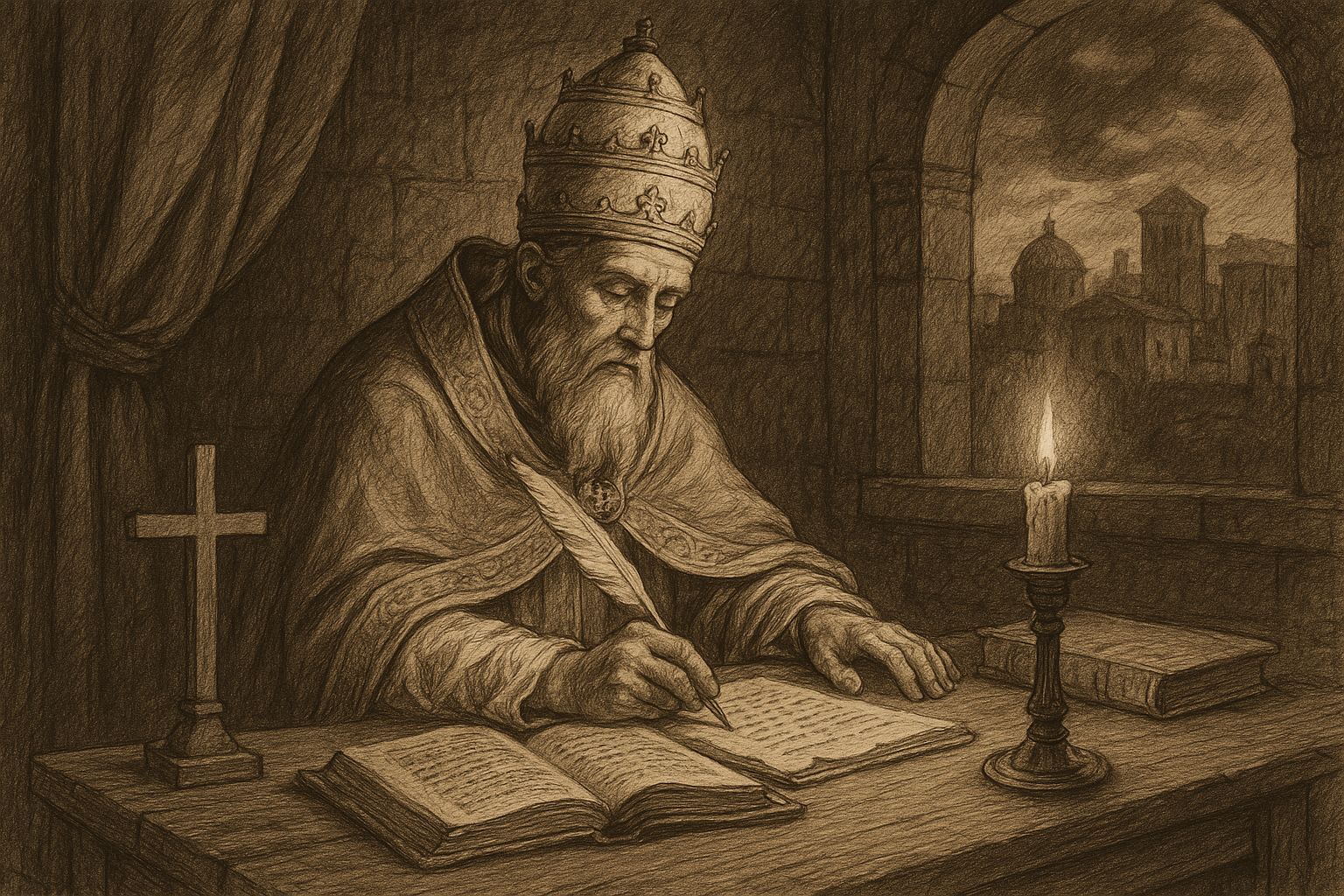
Gregory's legacy touches several areas of Catholic life. He strengthened pastoral care, encouraged discipline among clergy, promoted charitable service, and helped shape the Church's liturgical life. He was also a major writer. His Pastoral Rule became a classic work on the responsibilities of bishops and priests. In it, he reflected deeply on the dangers of pride, the need for humility, and the weight of spiritual leadership. He did not flatter office. He treated pastoral ministry as a serious obligation before God.
Gregory also gave attention to the organization of Church property and resources so that the poor would not be neglected. In practice, this meant that the pope had to act as a steward. Christian charity for him was not an abstraction. It involved food, support, order, and reliable care. His example shows that Catholic charity should be concrete. It should be visible in the way the Church handles resources and treats the vulnerable.
Another enduring part of his legacy is missionary zeal. Gregory sent St. Augustine of Canterbury and companions to evangelize England, a decision that helped shape the future of the Church there. This was not mere expansion for its own sake. Gregory believed the Gospel should be proclaimed to peoples who had not yet received it, and he trusted that God would use ordinary missionaries to accomplish extraordinary things.
Gregory and the Liturgy
Many Catholics associate Gregory with liturgy, and for good reason. The Roman liturgical tradition matured through many hands and many centuries, but Gregory played a key role in preserving and organizing the worship of the Church. He is often linked with the care and standardization of liturgical practice in the Roman rite, though the development of the liturgy was gradual and not the work of one man alone.
What matters most is his reverence for public worship. Gregory understood that the liturgy forms the mind and heart of the Church. It is not simply a useful gathering or a religious custom. It is the prayer of Christ's Body, offered to the Father in the Holy Spirit. When worship is well ordered, the faithful are taught to adore, repent, listen, and receive grace with humility.
That insight remains valuable today. Catholics often face pressure to treat worship as a matter of preference or style. Gregory's witness points in another direction. The liturgy belongs first to God, and only then to us. It should therefore be approached with care, fidelity, and reverence. A Church that prays well is better able to think clearly, serve generously, and evangelize without confusion.
A Doctor of the Church Who Teaches by Example
Gregory is honored as a Doctor of the Church, which means his teaching has lasting value for the whole Church. His influence did not come from abstract brilliance alone. It came from a life that matched his words. He wrote as a pastor, not as a theorist detached from suffering. His advice on leadership was born from experience. His concern for the poor was not sentimental. His view of the priesthood was sober because he knew how much damage pride can do when it enters sacred office.
One reason Catholics still turn to Gregory is that he speaks to common struggles. He understood fatigue, responsibility, temptation, and the burden of guiding others. He knew that leaders can become distracted by praise or discouraged by criticism. He knew, too, that the Church must not be managed like a worldly institution. It must be governed in humility, with eyes fixed on Christ.
His teaching also reminds the faithful that sanctity and competence are not enemies. Gregory was spiritual, but he was also effective. He prayed, but he also governed. He loved the contemplative life, yet he accepted public responsibility when obedience required it. That tension is familiar to many Catholics who long for prayer but must also work, parent, serve, and decide. Gregory offers a model of integrated discipleship.
Lessons for Catholics Today
St. Gregory the Great remains relevant because the problems he faced are not entirely foreign to our own. Many Catholics live in times of uncertainty, institutional fatigue, and social fragmentation. It is tempting either to panic or to drift. Gregory offers a better path.
First, he teaches patience with history. Christians are not called to despair when the world changes around them. Gregory did not pretend that Rome would return to its old strength. Instead, he served the Church in the world as it was. Catholics today can do the same by refusing nostalgia that becomes paralysis.
Second, he teaches disciplined charity. Love of neighbor must be practical. It should include mercy, organization, and faithful stewardship. Gregory's care for the poor shows that Church life is never only inward.
Third, he teaches reverence for worship. The liturgy is not a stage for personal expression. It is the Church's sacred work. Catholics who recover a sense of holy order in worship often find their whole spiritual life deepening with it.
Fourth, he teaches humility in leadership. Gregory knew that authority in the Church exists to serve. That lesson applies to clergy, parents, teachers, and anyone entrusted with responsibility. The best leaders do not make themselves central. They make Christ known.
Fifth, he teaches missionary confidence. The Gospel is still meant to be proclaimed. Gregory never reduced faith to maintenance. He looked outward. That missionary instinct remains necessary wherever Catholics are tempted to keep the faith private and hidden.
Reading Gregory as a Catholic Today
It is easy to admire great saints at a distance and leave them in the past. Gregory invites a more searching response. He asks whether our prayer is real, whether our service is concrete, and whether our worship shapes the way we live. He also asks whether we trust God enough to act without needing perfect conditions.
For Catholics, this is more than a historical lesson. It is a way of seeing the Church. The saints are not decorative figures. They are witnesses who reveal what grace can do in a human life. Gregory's era was troubled, but he did not let trouble have the last word. He held fast to the Church, strengthened her worship, defended her poor, and encouraged her mission.
That is why St. Gregory the Great Catholic history still speaks with clarity. He reminds us that holiness can govern, that liturgy can steady a people, and that faithful leadership can still bear fruit in hard times. His life suggests that the Church does not need to become less Catholic in order to meet a changing world. It needs saints who are deep in prayer, clear in doctrine, and generous in love.
In Gregory, Catholics can see how steadfast faith looks when the world is unsettled. It looks like prayer before work, worship before opinion, and charity before comfort. That is a legacy worth keeping close.
Keep Reading on Lets Read The Bible
Frequently Asked Questions
Why is St. Gregory the Great important in Catholic history?
He helped guide the Church through a difficult period after the fall of Roman stability, strengthened pastoral leadership, supported the poor, advanced missionary work, and influenced the Roman liturgical tradition.
How did St. Gregory the Great influence the liturgy?
He helped preserve and organize Roman liturgical practice and is associated with reverence for sacred worship. The liturgy developed over time, but his influence helped shape how Catholics understand ordered and faithful public prayer.
What can Catholics learn from St. Gregory the Great today?
Catholics can learn to unite prayer with action, practice practical charity, respect the liturgy, lead with humility, and trust God in times of social or institutional instability.