Prayer and Devotion
How to Make Room for Scripture Meditation in an Ordinary Catholic Day
A practical, prayerful way to let the Word of God rest in the heart and shape daily life.
Site Admin | December 7, 2025 | 78 views
Scripture as prayer, not just information
Many Catholics know the Bible is important, yet still feel unsure what to do with it once they open the page. Should we read quickly? Look for a lesson? Memorize a verse? Scripture meditation offers a calmer and more prayerful way forward. It invites us to linger with the Word of God until it begins to speak not only to our thoughts, but also to our conscience, our desires, and our daily choices.
In Catholic life, Scripture is never meant to be a private text detached from the life of the Church. It is proclaimed at Mass, contemplated in prayer, and received as living speech from the Lord. Saint Paul writes that all Scripture is inspired by God and useful for teaching, reproof, correction, and training in righteousness 2 Timothy 3:16. When we meditate on Scripture, we allow that inspired Word to do its work in us more deeply.
The Scripture meditation Catholic guide begins with a simple conviction: God is not far away, and his Word is not dead letters. He still speaks. The question is whether we are willing to slow down enough to listen.
What Scripture meditation is, and what it is not
Scripture meditation is a prayerful attention to a passage of the Bible. It is not the same thing as Bible study, though study can support it. It is not a performance of constant mental effort, and it is not a search for hidden messages or private revelations. It is the steady, reverent habit of staying with a text long enough for it to shape us.
A helpful way to think about it is this: reading brings the words before us, meditation lets the words settle in us, and prayer responds to what God has shown us. The Church has long encouraged this kind of encounter with Scripture because the Lord uses his Word to convert, console, instruct, and strengthen his people.
The Psalms are especially suited to this kind of prayer. They give voice to praise, fear, trust, sorrow, and hope. The whole Christian life can be found there. When the Psalmist says, your word is a lamp to my feet and a light to my path Psalm 119:105, he describes not only guidance for major decisions, but also the quieter light needed for one ordinary step after another.
Why it matters spiritually
Scripture meditation matters because the heart is rarely changed in a hurry. Much of our interior life is formed slowly, by repeated attention. We become what we behold. If our minds are fed only by noise, worry, and constant movement, prayer can start to feel thin. But if the Word of God is given time, it can begin to reorder our thinking and soften what has become hardened.
The Lord promises that his word does not return to him empty but accomplishes what he wills Isaiah 55:11. That promise gives courage to the Catholic who approaches the Bible in faith. Even when no emotion is felt and no sudden insight comes, the act of faithful attention is fruitful. God is at work in the quiet.
Scripture meditation also guards us from treating prayer as a one-sided monologue. We often come before God with lists, concerns, and requests. Those are good and necessary. Yet meditation reminds us that prayer is first a response to divine initiative. The Lord speaks first. We answer second. In this way, the Bible becomes not merely a source of ideas, but a meeting place with the living God.
Jesus himself models this kind of rootedness in the Word. In the desert, he answers temptation with Scripture Matthew 4:1 Matthew 4:4. He does not use Scripture as a slogan, but as a living expression of filial trust in the Father. For Catholics, meditation on Scripture is one way of learning that same trust.
A simple Catholic pattern for beginning
There is no single method that every Catholic must use, but a simple structure can help. The aim is not complexity. The aim is fidelity.
- Choose a short passage. Begin with a Gospel scene, a Psalm, or a brief passage from the Epistles. Many people do better with a few verses than with a large chapter.
- Come quietly before God. Make the Sign of the Cross. Ask the Holy Spirit to open the mind and heart. A short prayer like, Lord, speak, your servant is listening can help dispose the soul.
- Read slowly. Notice repeated words, actions, commands, or promises. Read the passage once or twice without rushing.
- Pause in silence. Let one phrase remain with you. Do not force a conclusion. Let the text rest in your attention.
- Respond in prayer. Speak honestly to the Lord about what the passage reveals. Offer praise, repentance, gratitude, petition, or trust.
- Carry one phrase into the day. A single verse can accompany you into work, travel, or family life. That little phrase can become a steady companion.
This is not a technique for controlling outcomes. It is a way of receiving grace. Like all real prayer, it can feel ordinary at first. But ordinary fidelity is often where spiritual depth begins.
Lectio divina and the Catholic imagination
Many Catholics will hear in this approach the long tradition of lectio divina, the slow and prayerful reading of Scripture. In that tradition, the text is not rushed. It is listened to with reverence. The reader moves from reading to meditation to prayer, and finally to contemplation, when God grants it.
This practice fits well with the Catholic imagination because it trusts that visible signs can carry invisible grace. We do not need to strip Scripture of its human texture in order to find God in it. The stories, images, commands, laments, and promises are themselves part of the way the Lord reaches us. The shepherd, the seed, the banquet, the lost sheep, the prodigal son, the Cross, the resurrection dawn, all of these become places where the believer learns to recognize the heart of God.
At times, the passage may seem to speak directly to a wound or confusion. At other times, it may simply reveal the beauty of Christ. Both are gifts. In either case, the goal is not to collect impressions but to be formed into discipleship. Be doers of the word, and not hearers only James 1:22. Meditation is meant to lead toward obedience, charity, and holiness.
When the mind wanders and prayer feels dry
Almost everyone who prays with Scripture discovers distraction. The mind jumps. Concerns intrude. Some days the passage seems flat and the heart feels resistant. None of this means the practice is failing.
In fact, returning gently to the text may be part of the prayer itself. Each time attention comes back to the Word, the soul makes a small act of love. The point is not to maintain perfect concentration. The point is to remain present before God with humility.
Dryness can also be spiritually useful. It reminds us that prayer is not primarily about a feeling we can produce. Faith is a gift, and meditation is a form of trust. When consolation is absent, we are asked to continue in love. That perseverance is precious in the eyes of God.
If a passage seems difficult, try another one. If a passage seems familiar, return to it anyway. Familiar texts often deepen over time. A verse read in youth can sound different in sorrow, in marriage, in illness, or after loss. Scripture has a way of remaining itself while meeting us anew in changing seasons.
How Scripture meditation connects with the sacraments
Catholic meditation on Scripture is not isolated from sacramental life. It is meant to support it. The same Lord who speaks in the Bible also nourishes us in the Eucharist, forgives us in Reconciliation, and strengthens us through the life of grace. Scripture helps dispose the soul to receive the sacraments more fruitfully, and the sacraments in turn deepen our ability to hear the Word.
The Mass is the clearest example of this relationship. We listen to the readings, answer in faith, and then encounter Christ sacramentally at the altar. Scripture meditation in private prayer extends that listening into the rest of the week. It helps us carry the liturgical Word into Monday, Tuesday, and beyond.
There is something beautifully Catholic about this rhythm. The Word proclaimed, pondered, and lived is not a self-enclosed spiritual exercise. It becomes part of a life ordered toward communion with Christ and his Church.
Practical ways to keep the habit alive
Many people begin Scripture meditation with enthusiasm and then struggle to maintain it. A few modest habits can make the practice sustainable.
- Keep the time brief and regular. Ten minutes each day is better than an ambitious plan that disappears after a week.
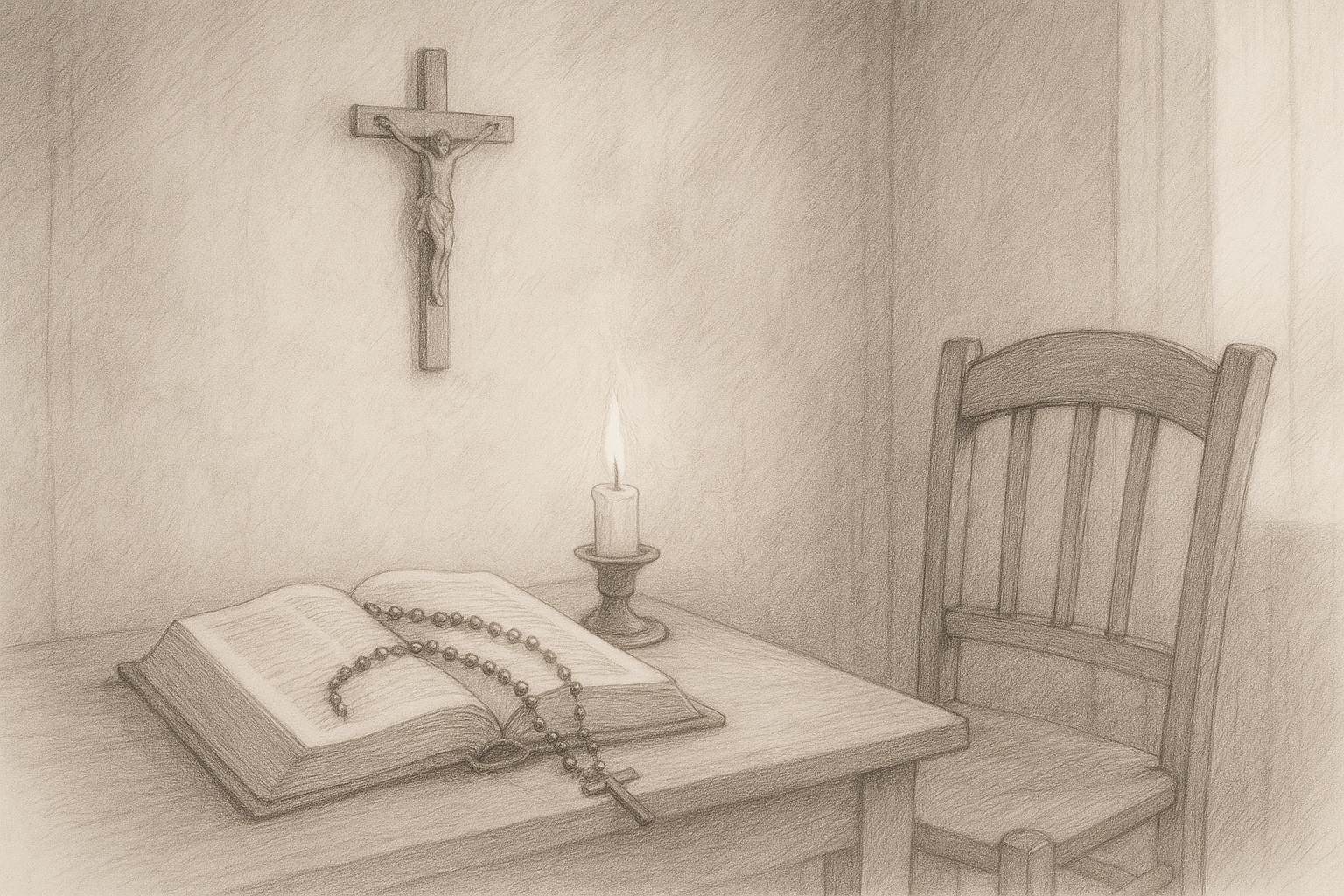
- Use the same place if possible. A quiet chair, a corner with a Bible and a crucifix, or a chapel can help create a prayerful rhythm.
- Link meditation to an existing habit. Morning prayer, evening prayer, or a pause before bedtime can serve as a natural anchor.
- Write down one phrase. A notebook can help you remember what stood out and how the Lord may be guiding you.
- Return to the Gospels often. Listening to Christ in his words and actions keeps meditation centered on the person of Jesus.
It is also wise not to measure success by dramatic feeling. Some of the richest prayer is hidden. The soul may be strengthened in ways that only become clear later. A quieter temper, a more patient response, a renewed desire to forgive, these can all be fruits of time spent with the Word.
Above all, approach Scripture with humility. The Bible is not a spiritual puzzle to solve. It is a gift to receive. The Lord speaks through it to lead us into conversion and love. When we open ourselves to that encounter, we begin to see that the Word of God is not merely read. It is inhabited.
Seek a passage not to master it, but to let it master your attention for a little while. In that surrendered attention, prayer begins to deepen.
For the Catholic who wants a simple and steady path, Scripture meditation offers a way to place the day under God's gaze. It can be done in a busy home, before work, after Mass, or in a few silent minutes at the end of the evening. The method is modest, but the grace can be great. The Word that created the world still has power to illumine the heart, and the heart that learns to listen will not remain unchanged.
Keep Reading on Lets Read The Bible
Frequently Asked Questions
What is the best Scripture passage for beginners to meditate on?
Many beginners start with a short Gospel passage, a Psalm, or a brief section from the Epistles. The key is to choose something manageable, then read it slowly and prayerfully rather than trying to cover too much at once.
Is Scripture meditation the same as lectio divina?
They are closely related. Lectio divina is a traditional Catholic pattern of prayerful Scripture reading that includes reading, meditation, prayer, and contemplation. Scripture meditation is often used more broadly, but it fits naturally within that tradition.
How long should Scripture meditation last?
There is no fixed rule. Even 10 to 15 minutes a day can be fruitful if it is done regularly and with attention. What matters most is faithful, prayerful contact with the Word of God.