Sacraments and Liturgy
In the Quiet Before the Blessed Sacrament
A practical look at Eucharistic adoration, its roots in the Church, and how ordinary Catholics can pray before the Lord with greater faith
Site Admin | September 10, 2025 | 70 views
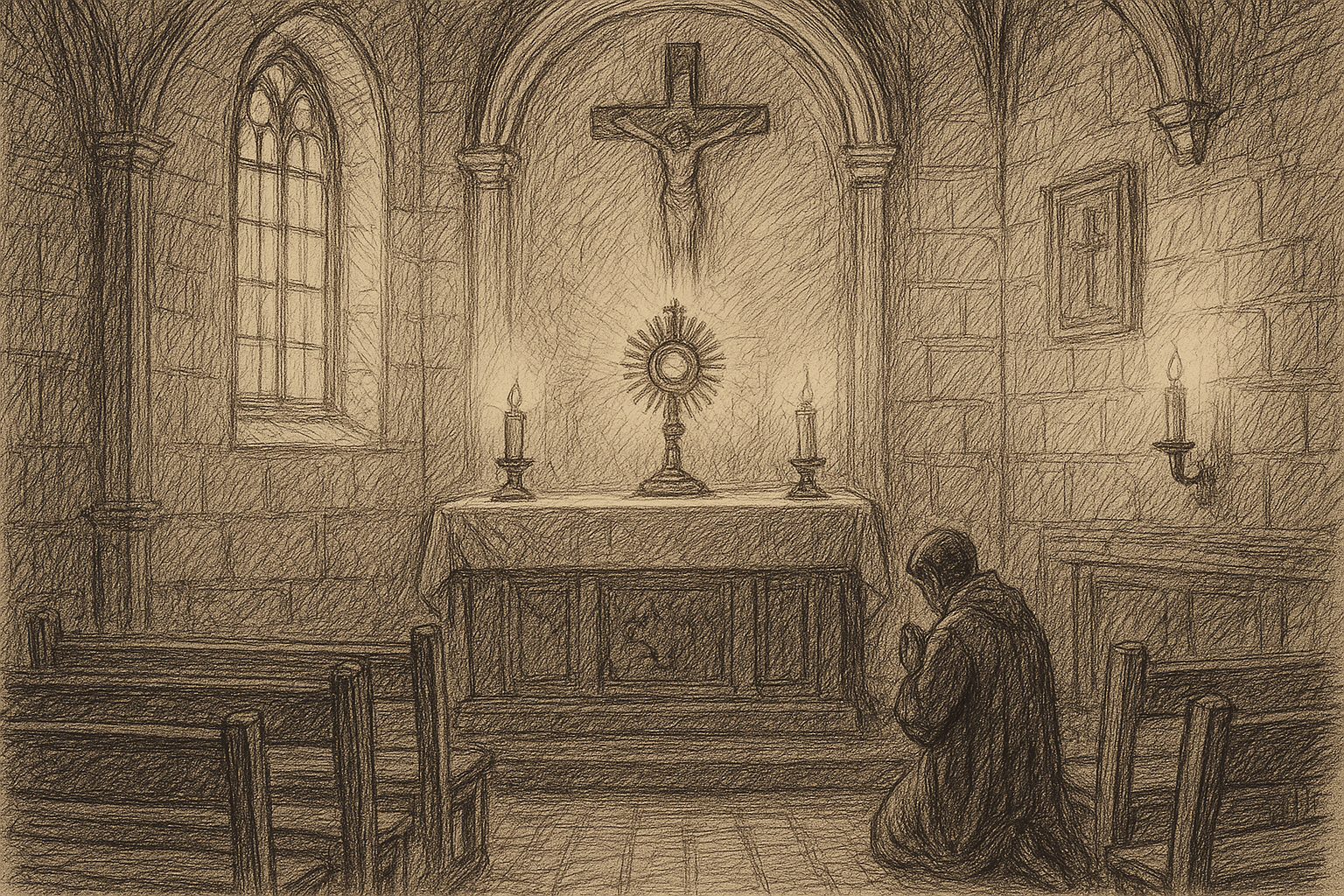
Eucharistic adoration has a way of slowing the soul. In a church or chapel where the Blessed Sacrament is exposed, the noise of ordinary life does not disappear, but it is placed in a different order. The heart begins to remember that Christ is not only spoken about, studied, or remembered from afar. He is truly present, given to his Church in the Eucharist.
For many Catholics, adoration is one of the most beautiful devotional practices in the life of faith, yet it can also feel mysterious. What are we doing when we kneel before the monstrance? Why has the Church treasured this practice for centuries? And how does an ordinary believer, perhaps distracted or tired, pray well in such silence?
What Eucharistic adoration is
Eucharistic adoration is prayer before Jesus Christ truly present in the Blessed Sacrament. When the Eucharist is exposed for public veneration, usually in a monstrance, the faithful adore the Lord who remains sacramentally present under the appearance of bread. The Church teaches that the Eucharist is not a symbol only, but the Body, Blood, Soul, and Divinity of Christ.
This is why adoration is never about admiring an object. It is about worshiping a Person. The same Jesus who feeds us at Mass is the one we kneel before in adoration. The posture may be silence, kneeling, singing, reading Scripture, using a prayer book, or simply resting in his presence. At the center is not our performance but his gift.
I am the living bread
Those words from the Lord in the Gospel of John sound especially clear in adoration. Christ does not merely point to life. He gives life. In the Eucharist, that gift is received, adored, and answered with love.
Where the practice comes from
Eucharistic adoration developed from the Church's faith in the Real Presence of Christ in the Eucharist. Once Christians began to understand more deeply the mystery of the sacrament, reverence naturally extended beyond the moment of reception at Mass. The faithful desired to remain near the Lord, to honor him, and to pray in his presence.
The Church's liturgical life has always centered on the Eucharist. Adoration grows from that center. It does not compete with the Mass or replace it. Rather, it extends the worship of the Mass into a sustained, contemplative posture. What is celebrated sacramentally at the altar is adored in silence by the faithful.
Over time, the Church gave shape to this devotion through solemn exposition, Benediction, and periods of prayer before the reserved Sacrament. These practices helped believers express what the faith already knew: Christ remains with his Church, and his nearness deserves reverence.
Why adoration matters
Adoration matters because love needs time. Much of modern life trains us to move quickly from one thing to another, even in prayer. Eucharistic adoration interrupts that habit. It asks us to be still long enough to recognize that we are not in control, and that this is a grace.
It also teaches us to believe with the whole person, not just the mind. Catholics confess the Real Presence at Mass, but adoration gives the body a chance to say what the heart believes. Kneeling, bowing, making the sign of the cross, and sitting in silence all become acts of faith. In a world that prizes noise and motion, the stillness of adoration is its own witness.
Adoration can also deepen our participation in the Mass. When we spend time with the Lord in the Blessed Sacrament, the Eucharistic liturgy is no longer an isolated hour on Sunday. It becomes the center toward which the rest of the week turns. The prayer of adoration gathers up thanksgiving, repentance, petition, and trust, then sends them back into daily life.
Come to me, all who labor
That invitation is not abstract. It is personal. The tired, anxious, burdened, and distracted are not turned away from Christ. They are called to him. In adoration, the Church answers that call with her presence.
How adoration shapes the Catholic heart
Adoration forms habits that are easy to lose elsewhere. It teaches patience, because prayer before the Blessed Sacrament cannot be rushed. It teaches humility, because the Lord is God and we are not. It teaches gratitude, because the Eucharist itself is pure gift. And it teaches friendship with Christ, not as a sentimental idea, but as a real and abiding relationship.
Many Catholics discover that adoration reveals what is truly going on inside them. The quiet can feel comforting, but it can also make us aware of distraction, restlessness, or hidden sorrow. This is not failure. It is often the beginning of honest prayer. Before the Lord, we do not need to pretend to be more polished than we are. We need only come with trust.
Adoration also helps purify our intentions. It is easy to seek prayer mainly for consolation, clarity, or answers. Those things matter, but adoration first places us before Christ himself. We come not only to get something from him, but to be with him. That simple shift can change the whole spiritual life.
A simple way to pray when you are there
If adoration feels unfamiliar, it helps to keep the prayer simple. You do not need an elaborate method. You need a willing heart. Here is one ordinary pattern that many Catholics find helpful:
- Begin with reverence. Make the sign of the cross slowly and become aware that you are before the Lord.
- Offer a short act of faith. For example, quietly tell Christ that you believe he is truly present.
- Read a brief passage of Scripture, especially from the Gospels or the Psalms.
- Remain in silence for a few minutes, returning gently to the Lord whenever your mind wanders.
- Bring him your thanks, your needs, your sins, and the names of those you love.
- Close with a prayer such as the Our Father, the Hail Mary, or a simple word of praise.
There is no need to fill every minute with words. Silence in adoration is not emptiness. It is attentive presence. If the mind drifts, return without frustration. If all you can manage is a few words, that is enough. The Lord already knows your need.
What to do when prayer feels dry
Dryness in adoration is common. Sometimes the chapel feels peaceful and prayer flows easily. Other times it feels like nothing is happening. Faith remains the same even when feeling changes. In those moments, it helps to stay faithful to a simple act: look at the host, repeat a short prayer, read one verse, or sit quietly and offer the time itself.
Dry prayer can be fruitful precisely because it is not driven by emotional comfort. It becomes a pure offering. The Church has always known that love is not measured by intensity alone. Often, love is measured by fidelity.
Adoration and the Mass belong together
It is important to remember that Eucharistic adoration does not stand apart from the liturgy. It flows from the Mass and returns to it. The Eucharist is given to the Church in the sacrifice and banquet of the altar, and adoration extends that same mystery into contemplation.
In this way, adoration keeps the Eucharist from becoming routine. It reminds us that what happens at Mass is holy beyond measure. The Lord does not come to us as an idea, but as sacramental reality. A culture of adoration can help Catholics approach the liturgy with greater attention, greater gratitude, and greater awe.
Do this in memory of me
Christ's command at the Last Supper does more than institute a rite. It establishes a living memory, one that is sacramental and worshipful. The Church remembers by celebrating, receiving, and adoring.
Making adoration part of ordinary life
Not everyone can spend long hours in a chapel, and not every parish has frequent exposition. But nearly every Catholic can find some way to make adoration part of life. A visit to the tabernacle after Mass, a weekly holy hour, a few minutes before work, or a quiet stop in a church during the day can all become real encounters with Christ.
The key is consistency. A short, regular visit often bears more fruit than a rare, ambitious one. If adoration is new to you, start small. Arrive on time. Leave distractions behind. Put away the phone. Sit before the Lord without forcing yourself to produce feelings. Over time, the soul learns how to settle into his presence.
It can also help to connect adoration to the rest of the Christian life. Bring the Scripture you heard at Mass. Pray for the people you will meet. Offer your work, your family concerns, and your suffering. In this way, adoration becomes a place where Sunday faith meets weekday reality.
What the saints have often understood
The saints consistently show that closeness to Christ in the Eucharist bears fruit in charity and mission. They do not treat adoration as escape from the world, but as a place of renewal for service in the world. Time before the Blessed Sacrament softens pride, deepens compassion, and steadies the soul for sacrifice.
That is one reason adoration remains so valuable. It reminds the Church that action must be rooted in worship. Before we serve, we kneel. Before we speak, we listen. Before we try to change anything, we let Christ look upon us and form us.
For the Catholic who wants to live this devotion more deeply, the invitation is simple and demanding at once: come back to the Lord often. Let the Eucharist be not only something received on Sunday, but Someone adored in the quiet of the week. There, in the stillness before the Blessed Sacrament, the heart learns again that Jesus is enough.
Keep Reading on Lets Read The Bible
- Listening at Mass: The Liturgy of the Word and the Church's Living Voice
- At the Table of the Word: Meeting Christ in the Scriptures at Mass
- At the Heart of the Mass: Living the Liturgy of the Eucharist with Attention and Faith
- Entering the Mystery: The Introductory Rites of Mass and the Art of Beginning Well
Frequently Asked Questions
Is Eucharistic adoration the same as attending Mass?
No. Mass is the sacrifice of Christ made present sacramentally, and the faithful receive Holy Communion there. Eucharistic adoration is prayer before Christ present in the Blessed Sacrament, usually outside of Mass. The two are closely connected, but they are not the same act.
What should I do during Eucharistic adoration if I do not know how to pray?
Start simply. Make the sign of the cross, believe that Christ is truly present, read a short Scripture passage, and remain quietly before him. You can use traditional prayers, repeat a short line from Scripture, or sit in silence. Faithful presence matters more than having many words.
Does Eucharistic adoration have to be long to be worthwhile?
No. Even a few minutes can be fruitful if they are given with reverence and sincerity. A regular short visit is often more helpful than an occasional long one. What matters most is coming before the Lord with faith and love.