Sacraments and Liturgy
Inside the Heart of the Mass: The Liturgy of the Eucharist
A practical Catholic look at the Church's most sacred moment and how to receive it with deeper faith.
Site Admin | September 6, 2025 | 84 views
The Mass is not all the same in intensity. Some parts prepare us, some gather us, and some form us in prayer. But the Liturgy of the Eucharist is the place where everything sharpens into one holy act: Christ gives Himself to the Church.
For many Catholics, this is the moment that feels most sacred because it is. The altar, the gifts, the words of consecration, the elevation, Holy Communion, and the final prayer over the people all belong to a single movement of offering and thanksgiving. The Church calls it the Liturgy of the Eucharist because it is both worship and gift, both sacrifice and meal.
If you are looking for a practical, faithful, and clear the Liturgy of the Eucharist Catholic guide, the best place to begin is with the simple truth that the Mass does not merely remember Jesus. It makes present His once-for-all sacrifice in an unbloody sacramental manner. Catholics do not approach the altar as spectators. We stand where Christ is acting for us and with us.
What the Liturgy of the Eucharist is
The Liturgy of the Eucharist begins after the Prayer of the Faithful and includes the preparation of the gifts, the Eucharistic Prayer, the Communion Rite, and the concluding prayers. In this part of the Mass, the Church offers bread and wine, and God transforms them into the Body and Blood of Jesus Christ through the power of the Holy Spirit and the words of the priest.
The structure is simple, but the reality is profound. Christ takes the ordinary gifts of human labor and creation and makes them the place of His saving presence. The Church sees this not as a symbol only, but as a sacramental mystery grounded in the words and action of Jesus at the Last Supper: [[VERSE|luke|22|19-20|This is my body... this cup]] and [[VERSE|1-corinthians|11|23-26|Do this in remembrance of me]].
The word Eucharist means thanksgiving. That is no small detail. At the center of the Mass is gratitude toward the Father through the Son in the Holy Spirit. We thank God not just for gifts, but for the gift of Himself. This is why the liturgy has such a solemn beauty. It is not decorative. It is fitting.
Where the Liturgy of the Eucharist comes from
The roots of this liturgy reach into the Passover, the covenant sacrifices of Israel, the meals of Jesus with His disciples, and the Last Supper in the upper room. The Church has always understood the Eucharist in the light of those Scriptures. The Passover was not simply remembered by Israel as a past event. It was celebrated as a saving act made present to the people. In Christ, that pattern finds its fulfillment.
At the Last Supper, Jesus did more than offer a farewell meal. He identified bread and wine with His body and blood, and He commanded the apostles to continue the act in memory of Him. The Church has faithfully obeyed that command from the beginning. In the Acts of the Apostles, the first Christians are described as persevering in the breaking of the bread Breaking of the bread. That phrase is one of the earliest names for Eucharistic worship.
St. Paul also testifies to the seriousness of this mystery. He warns the Corinthians that the Eucharistic cup and bread are a participation in the body and blood of Christ Participation in the body and blood, and he speaks with unusual force about the need to receive worthily [[VERSE|1-corinthians|11|27-29|Receive worthily]]. The Church did not invent reverence for the Eucharist centuries later. She received it from the apostolic witness itself.
The Fathers of the Church also speak with remarkable unity on this point. From the earliest centuries, Christians understood the Eucharist as the true Body and Blood of the Lord, not a merely symbolic meal. That continuity matters. The Mass is not a late devotional layer added onto Christianity. It is one of the Church's oldest and most enduring acts of worship.
Why it matters for Catholic life
The Liturgy of the Eucharist matters because it is where Christ feeds the Church with His own life. A Catholic is not sustained by ideas alone. We are sustained by grace, and grace is given sacramentally. In the Eucharist, the Lord comes to us under humble signs so that faith may be purified and love deepened.
This is why the Mass is more than a weekly obligation, even though it is that. It is the center of Christian existence. The same Jesus who healed the sick, forgave sinners, and gave His life on Calvary gives Himself now in the Eucharist. In every Mass, the Church is drawn into the sacrifice of Christ and into communion with Him.
That has practical consequences. A Catholic who truly understands the Liturgy of the Eucharist will begin to see Sunday not as a break from real life but as its source. The altar teaches us that our work, sufferings, family life, and hidden sacrifices can be offered to God. The gifts of bread and wine represent the offering of our whole selves.
The Eucharist is not only something we receive. It is also the pattern of the Christian life: offered, consecrated, given, and shared.
The liturgy also teaches humility. At the altar, we do not place ourselves at the center. We kneel before a gift we did not create and cannot control. That humility is not weakness. It is the doorway to worship. It reminds us that salvation is received, not achieved.
The main movements of the rite
Each part of the Liturgy of the Eucharist helps the faithful enter more deeply into the mystery. Even when the words are familiar, the meaning is rich.
The preparation of the gifts
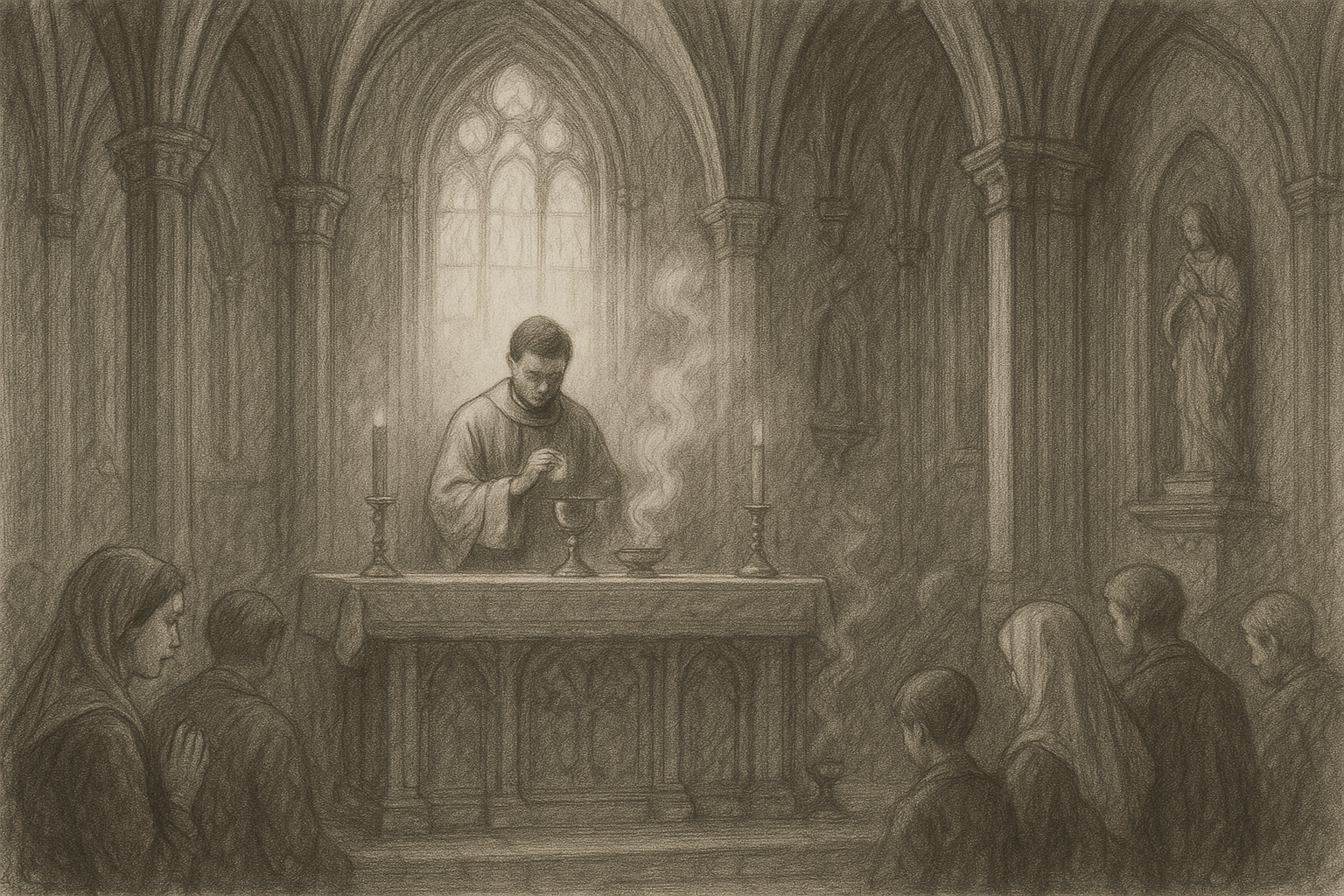
Bread and wine are brought to the altar. This is often a simple moment, but it carries great meaning. The gifts represent creation, human labor, and the lives of the faithful. The priest prays that God may accept them, and the people respond with faith. In a quiet way, the Church is learning to offer herself.
The Eucharistic Prayer
This is the center of the center. In the Eucharistic Prayer, the priest asks the Father to send the Holy Spirit, recalls the saving work of Christ, and pronounces the words of consecration. The Church believes that the bread and wine become the Body and Blood of Christ. The visible appearances remain, but their substance is changed by God's power.
The prayer is filled with awe because it is not merely spoken about Christ. It is spoken in Christ. The Church joins His own prayer of thanksgiving and sacrifice to the Father. This is why silence, attention, and reverence matter so much here.
The memorial acclamation and intercessions
After the consecration, the people proclaim the mystery of faith. This is not an interruption. It is the Church's living response to Christ's saving death and resurrection. The Eucharist always points to the Paschal Mystery, the death and resurrection of the Lord.
The prayer then widens to include the Church, the pope, the bishops, the dead, and all the faithful. The Eucharist is never private. It is the prayer of the whole Church, living and dead, united in one body.
The Communion Rite
After the Lord's Prayer and the sign of peace, the faithful prepare to receive Communion. The priest breaks the host, echoing the ancient breaking of the bread, and the people proclaim their unworthiness with trust:
Keep Reading on Lets Read The Bible
Frequently Asked Questions
What is the main purpose of the Liturgy of the Eucharist in the Mass?
Its main purpose is to make present the sacrifice of Christ and unite the Church to Him in thanksgiving, offering, and Communion. Bread and wine are consecrated and become the Body and Blood of the Lord.
Why do Catholics kneel and show reverence during the Eucharistic Prayer?
Because the Church believes something holy and unique is taking place at the altar. Reverence expresses faith in Christ's real presence and in the sacred character of the sacrifice being offered.
How can an ordinary Catholic participate more deeply in the Liturgy of the Eucharist?
By arriving prepared, following the prayers attentively, making a sincere act of self-offering, and receiving Communion with faith, repentance, and gratitude.