Sacraments and Liturgy
Keeping Vigil with Christ: A Catholic Look at Eucharistic Adoration
A reverent introduction to the Church's prayer before the Blessed Sacrament, from its roots in faith to the simple steps that help Catholics pray well.
Site Admin | September 11, 2025 | 63 views
Meeting the Lord in silence
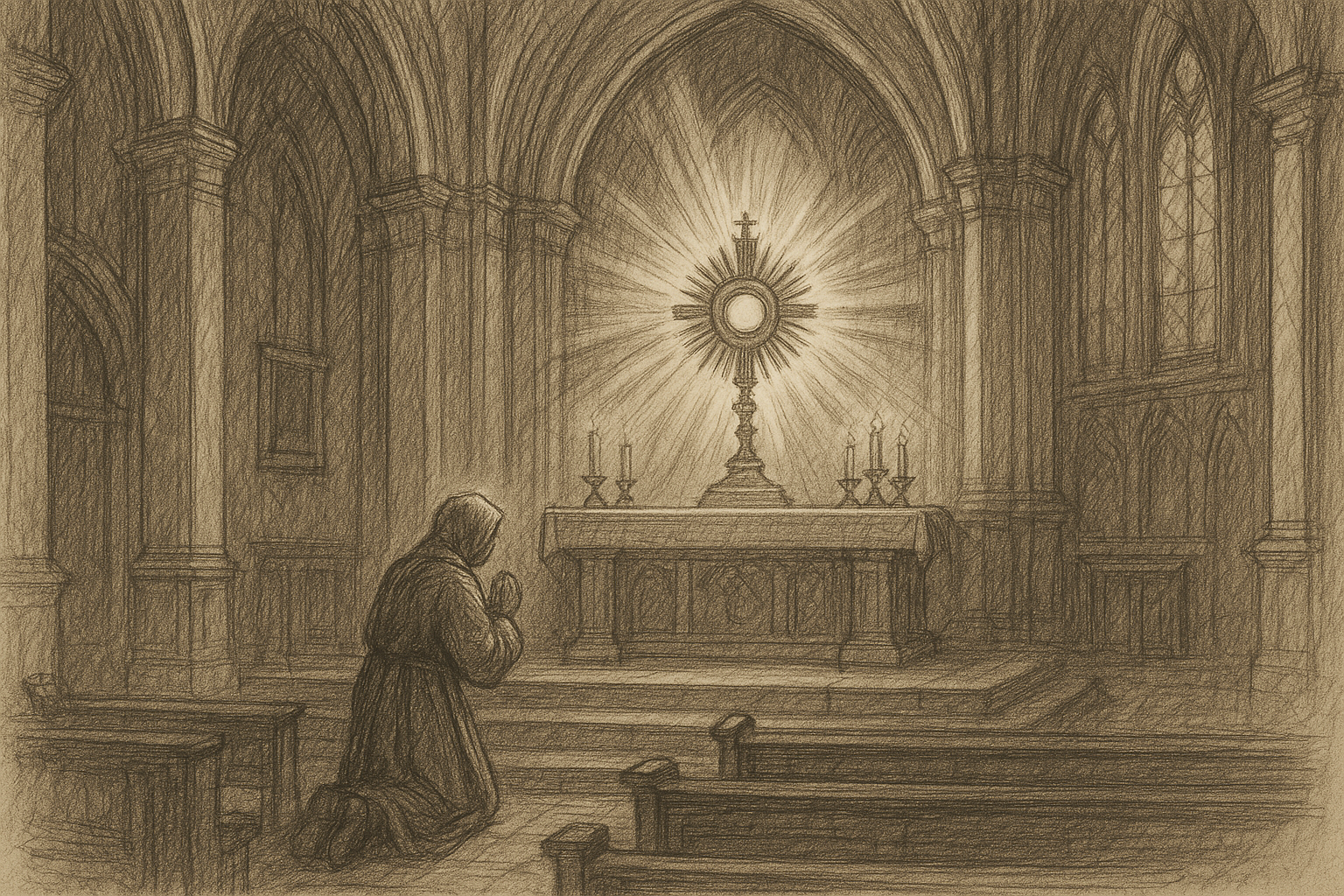
Eucharistic adoration is one of the most beautiful and disarming forms of Catholic prayer. It places the believer before the Blessed Sacrament and asks for something simple, but not always easy: to remain with Christ in faith, love, and reverence. In an age that prizes noise, speed, and constant movement, adoration offers a different rhythm. It is not about producing words. It is about being with the Lord who has already drawn near.
For many Catholics, the first question is basic: what exactly happens in adoration? The answer begins with a central truth of the faith. The Eucharist is not a symbol left behind after Mass. Through the mystery of transubstantiation, the bread and wine become the Body and Blood of Christ. Because Jesus is truly present in the sacrament, the Church honors the Blessed Sacrament with worship. Adoration is that worship expressed in prayerful stillness before Christ present under the appearance of bread.
That presence is not abstract. It is personal. When Catholics kneel or sit before the monstrance, or even before the reserved sacrament in a tabernacle, they come before the same Lord who spoke, healed, forgave, and gave Himself on the Cross. The invitation is not to inspect a holy object, but to encounter a living Person.
The roots of adoration in Scripture and the life of the Church
Although the forms of Eucharistic adoration developed over time, its heart is deeply biblical. The Gospel of John presents Jesus as the Bread of Life, giving His flesh for the life of the world John 6:51. At the Last Supper, He takes bread and says, "This is my body" Luke 22:19. Saint Paul warns the Corinthians that the Eucharist is not a common meal, and that to receive it unworthily is to sin against the Body and Blood of the Lord 1 Corinthians 11:27. These passages do not merely support devotion to the Eucharist. They reveal its meaning.
From the earliest centuries, Christians treated the Eucharist with extraordinary reverence. The Church gathered for the breaking of the bread, and believers treasured the sacrament as the Lord's own gift. Over time, as faith in the Real Presence was articulated more precisely, the Church developed public expressions of Eucharistic worship outside of Mass. Processions, blessings, and prolonged exposition of the Blessed Sacrament grew as acts of love and faith. Adoration did not replace the Mass. Rather, it flowed from the Mass and led believers back to it with greater awareness and gratitude.
One important moment in this history was the Church's clearer language about the Eucharist's abiding presence. Because Christ remains truly present in the consecrated species, the sacrament may be reserved in the tabernacle for Communion of the sick and for prayer. From that reserved presence, the practice of adoration took visible shape. The Church's teaching has consistently held that worship given to the Eucharist is worship given to Christ Himself.
What adoration is, and what it is not
It helps to distinguish adoration from other forms of prayer. In adoration, Catholics do not come primarily to speak at length, though words may certainly arise. They come to adore, to gaze, to listen, to remain. A person may recite the Rosary, read Scripture, or pray silently before the Blessed Sacrament. The essential posture is one of reverence before the living Lord.
Adoration is not a time for performance or spiritual pressure. It is not measured by how emotional a person feels, how many insights come, or how still the mind remains. Some of the most fruitful hours are quiet and uneventful from a human point of view. Yet faith teaches that hidden prayer has its own depth. The Lord is not less present when the heart feels dull. In fact, perseverance in dry prayer can be a profound act of trust.
Nor is adoration a substitute for the sacramental life. It does not stand apart from Sunday Mass, confession, prayer at home, or works of mercy. It strengthens them. Time before the Blessed Sacrament tends to make the rest of Catholic life more orderly and more centered. The soul begins to recognize what matters most: Christ, given and received, adored and followed.
Why the Church invites us to this form of prayer
There is something quietly healing about being in the presence of Jesus without agenda. Many people are accustomed to prayer as request, reflection, or mental effort. Adoration expands the imagination of prayer. It teaches that love is not always active in obvious ways. Sometimes love waits. Sometimes love keeps watch. Sometimes love simply remains.
This is one reason adoration can be especially fruitful for Catholics who struggle with distraction, sorrow, or spiritual dryness. Before the Blessed Sacrament, a person does not need to manufacture holiness. The Lord Himself is the center. His presence steadies the heart. It reminds the believer that grace is received, not achieved. Adoration can also awaken gratitude for the Mass, where the same Christ who is adored is also offered sacramentally and received in Holy Communion.
The Church encourages devotion to the Eucharist because it nurtures faith in the Real Presence and deepens love for the Savior. Saint Thomas Aquinas expressed this beautifully in the hymns and prayers he wrote for the feast of Corpus Christi. His theological precision and poetic devotion both point to the same truth: Christ has remained with His Church, and the Church responds with worship.
Before the Eucharist, the believer learns that the greatest spiritual acts are often the simplest: kneeling, staying, adoring, and letting Christ be Lord.
How to prepare for adoration
For someone new to Eucharistic adoration, preparation can remove much of the uncertainty. There is no special technique to master. Still, a few practical habits help the time become more prayerful and peaceful.
- Arrive with a recollected mind. If possible, arrive a few minutes early and allow the noise of the day to settle.
- Dress simply and reverently. The point is not to impress anyone, but to show respect for the Lord present in the sacrament.
- Make an act of faith. A simple interior prayer such as, "My Lord and my God," can help orient the heart.
- Bring Scripture or a prayer book if helpful. Many Catholics find a psalm, the Gospels, or the Rosary to be a natural companion in adoration.
- Keep silence when possible. Silence is not emptiness. It is a space where reverence can grow.
It also helps to remember that adoration is usually available in specific settings. Sometimes the Blessed Sacrament is exposed in a monstrance, and sometimes prayer is made before the tabernacle. The posture of the heart should remain reverent in either case. If the Blessed Sacrament is exposed, local customs and parish guidance may include kneeling on entering and leaving, or making a genuflection when appropriate. These gestures are not empty forms. They express what the body believes.
What to do during adoration
Once a person is before the Lord, the question often becomes: what now? The answer is simpler than many expect. Begin by acknowledging Christ's presence. Then pray in a way that is honest and measured. Some people begin with thanksgiving for the Mass, for family, for mercy received, or for the gift of faith. Others quietly offer concerns, temptations, or burdens to the Lord.
Reading a passage of Scripture can be especially fitting. The Gospels, the Psalms, and the Eucharistic passages of John 6 are natural places to start. A person might read slowly, pause, and allow a phrase to remain in the heart. The Rosary can also harmonize well with adoration because it keeps the mysteries of Christ before the soul. If words are difficult, simply sitting in silent attention is enough.
Some helpful patterns include the following:
- Adore. Acknowledge that Jesus is present and worthy of worship.
- Thank. Recall gifts received, especially the gift of the Eucharist itself.
- Ask. Bring needs, sins, anxieties, and intercessions before Him.
- Listen. Allow silence and Scripture to shape the heart.
- Offer. Place one's life, work, family, and future in Christ's hands.
If the mind wanders, do not be alarmed. Gently return attention to the Lord. Adoration is less about perfect focus than faithful presence. Children, beginners, and seasoned Catholics alike can pray there. The Lord receives each person with patience.
Common misconceptions about adoration
Because Eucharistic adoration is so quiet, it can be misunderstood. Some think it belongs only to the deeply devout or to those with abundant free time. In truth, it is for every Catholic who desires to love Christ more. Others assume that adoration is a private devotion detached from the liturgy. But adoration grows from the Mass and points back to it. The liturgy remains the center of Catholic worship, and adoration serves that center.
Another misconception is that adoration requires strong feelings. It does not. Faith is not proved by emotion. A person may leave adoration with great consolation, or with little visible change, and still have prayed well. The grace of prayer often ripens slowly. In a culture that wants immediate results, adoration teaches patience.
It is also worth saying that adoration is not magical in the superstitious sense. The Eucharist is holy because Christ is truly present, not because a certain atmosphere has been created. Grace works through faith, reverence, and sacramental reality, not through religious mood alone.
How adoration forms the Christian life
Time before the Blessed Sacrament tends to leave its mark on daily life. A Catholic who adores regularly may find greater attentiveness at Mass, a stronger sense of sin and mercy, and a deeper desire for prayer during the week. Adoration can sharpen conscience and soften the heart. It can also help a person rediscover the dignity of silence in family life, work, and ordinary responsibilities.
It is not unusual for Catholics to describe adoration as a school of love. There, the believer learns that Christ is not distant. He remains with His people. He sees the burdens they carry, the prayers they cannot yet speak, the hope they struggle to hold. In return, He asks for trust. The fruit is often quiet but real: greater peace, more humility, more desire for holiness, and a clearer hunger for the sacraments.
Adoration can also become a place of intercession. Many Catholics bring the needs of the Church, the suffering of the world, and the intentions of loved ones before the Lord. In this way, the hour becomes larger than the self. The heart expands in charity because it stands before the One who gave Himself for all.
To remain before Christ in the Eucharist is to allow love to have the first and last word. That may sound simple, but it changes a life. In the stillness of adoration, the Church learns again that the Lord she worships in the sacrament is the same Lord who sends her into the world with mercy, truth, and peace.
Keep Reading on Lets Read The Bible
Frequently Asked Questions
What is Eucharistic adoration in the Catholic Church?
Eucharistic adoration is prayer before Jesus Christ, who is truly present in the Blessed Sacrament. Catholics worship Him in silence, thanksgiving, Scripture, or other prayers, especially when the Eucharist is exposed in a monstrance or reserved in the tabernacle.
Do I have to say specific prayers during adoration?
No. There is no required formula for adoration. You may pray silently, read Scripture, pray the Rosary, make acts of faith and love, or simply remain peacefully before the Lord.
How should a beginner spend an hour of adoration?
A beginner can start simply: make a reverent sign of the cross, acknowledge Christ's presence, spend time in thanksgiving, read a short Gospel passage, bring personal intentions, and rest in silence when words run out.