Sacraments and Liturgy
Keeping Watch Before the Lord: A Catholic Way of Entering Eucharistic Adoration
A practical, prayerful look at the Church's quietest devotion and how ordinary Catholics can live it with greater faith.
Site Admin | August 28, 2026 | 70 views
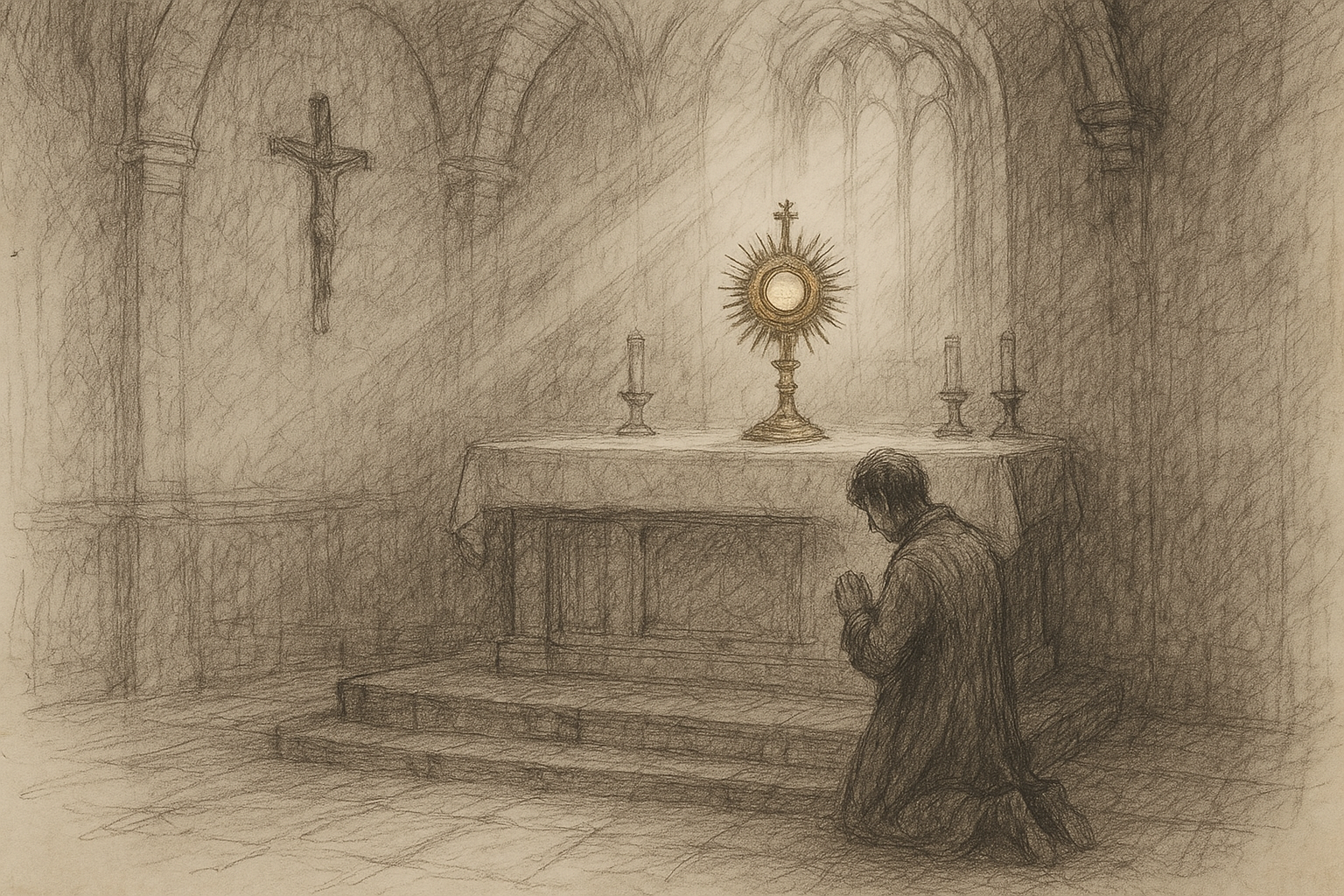
Eucharistic adoration is one of the most quietly powerful devotions in the Catholic Church. It asks for very little on the outside, but it can ask everything of the heart. A person enters a chapel, kneels before the Blessed Sacrament, and simply stays with the Lord who gave himself for the life of the world. There may be silence. There may be hymns, a rosary, Scripture, or a few whispered prayers. Often there is nothing but the steady faith of the Church and the humble certainty that Christ is truly present.
For many Catholics, adoration is deeply familiar, but not always well understood. Some know it as an hour of silence before the monstrance. Others remember a holy hour from a retreat, a parish vigil, or a weekday visit to the tabernacle. Still others have never been invited into it at all and wonder what makes it different from private prayer at home. The answer is simple and beautiful: Eucharistic adoration is prayer before Jesus Christ present in the Eucharist, the same Lord whom the Church receives at Mass and reserves in reverence for worship.
What the Church means by adoration
Adoration is not first of all an activity or a technique. It is an act of worship. When Catholics adore the Eucharist, they are not treating a consecrated host as a religious symbol or as a moment of spiritual mood. They are honoring the living Christ, truly present in his Body, Blood, Soul, and Divinity, under the appearance of bread. The Church reserves the Eucharist because the Eucharist is not ordinary bread at all after the consecration. It is the sacramental presence of the Lord who said, "This is my body" This is my body and "This is my blood of the covenant" This is my blood of the covenant.
That is why adoration is so closely connected to the Mass. The Mass is the source and summit of the Christian life, and adoration flows from that same mystery. At Mass, the Church offers praise and receives the Lord in Holy Communion. In adoration, the Church lingers in grateful silence before the same Jesus, now reserved in the tabernacle or exposed in a monstrance for prayer. The movement is not away from the liturgy, but deeper into it. Adoration grows from the Eucharist and returns the soul to the Eucharist with greater devotion.
It is important to say this plainly: adoration is not a replacement for Mass, and it is not meant to be separated from the Church's sacramental life. Rather, it helps dispose the heart to receive the sacrament more fruitfully. A Catholic who adores well learns how to receive well, because adoration trains the soul in humility, reverence, gratitude, and love.
Where this devotion comes from
The roots of Eucharistic adoration lie in the Church's belief from the beginning that the Eucharist is truly the Lord's gift to his people. The New Testament already shows a Church centered on the breaking of the bread, on reverent gathering, and on the worship of Christ present among his own. Jesus promised more than memory when he said, "He who eats my flesh and drinks my blood has eternal life" He who eats my flesh and drinks my blood has eternal life. The realism of that promise shaped Christian worship from the earliest centuries.
As Catholic doctrine developed more clearly over time, the Church grew in her liturgical practice of reserving the Blessed Sacrament and honoring Christ's presence outside Mass. The faithful began visiting the reserved Eucharist for prayer, thanksgiving, petition, and silent devotion. Over time, formal exposition became part of the Church's devotional life, especially for times of extended prayer, benediction, and solemn worship. Yet the heart of the devotion remained unchanged: the Church believed she was before the Lord himself.
The saints understood this with simplicity. They did not treat Eucharistic prayer as an ornament for the spiritually advanced. They saw it as a school of love. A holy hour is not about collecting feelings or proving discipline. It is about staying close to Jesus, especially when prayer feels ordinary, dry, or distracted. The very patience of adoration becomes prayer. Sitting in faith before the Lord can purify motives in a way that busier forms of devotion sometimes cannot.
Why adoration matters for ordinary Catholics
Many Catholics are accustomed to thinking of prayer as words we say to God, which is true. But Eucharistic adoration reminds us that prayer is also presence. We place ourselves before the Lord and let him look upon us. That simple exchange can be difficult in a restless age. We are used to filling silence with noise, and even our spiritual lives can become crowded with tasks. Adoration interrupts that habit. It gives space for the truth that God is God and we are not.
In adoration, a Catholic learns to receive mercy without having to perform. This is especially important for people who carry guilt, fatigue, grief, or spiritual dryness. The Blessed Sacrament does not depend on our emotional clarity. Christ remains present whether we feel strong or weak, grateful or scattered. In that quiet setting, the soul can slowly become honest before him. Some people discover that adoration helps them forgive. Others find courage to confess sins they have avoided. Still others simply sit in silence and are healed by the Church's patient nearness to the Lord.
Adoration also deepens gratitude. When we kneel before the Eucharist, we are not only remembering that Jesus died for us. We are acknowledging that he remains with us. The Lord who fed the multitudes, washed the disciples' feet, suffered on the cross, and rose from the dead still gives himself to his Church. That is why adoration is not sentimental piety. It is a response to the living gift of Christ. "Do this in remembrance of me" Do this in remembrance of me is not only a command to celebrate the Mass, but an invitation to remain in grateful communion with the One whom the Mass makes present.
How to enter adoration without feeling overwhelmed
Many people avoid Eucharistic adoration because they are afraid of doing it wrong. They imagine there is a hidden method or a prayer performance expected of them. In reality, the simplest approach is often the best. Bring yourself to the Lord honestly, and stay with him. If the chapel is silent, let the silence be part of the prayer. If a prayer book helps, use it sparingly. If a rosary steadies your attention, pray it. If Scripture opens your heart, read slowly and pause often.
A practical holy hour might unfold in a few simple movements:
- Begin by making the sign of the cross and acknowledging Christ's presence.
- Spend a few moments becoming still and offering your intentions.
- Read a short passage from the Gospels, especially words of Jesus.
- Speak to the Lord in simple language, with thanksgiving, sorrow, petition, or praise.
- Leave room for silence, even if it feels awkward at first.
- End with a prayer of trust, such as the Our Father, the Hail Mary, or a spontaneous act of love.
The aim is not to fill every minute. The aim is to remain with Jesus. Adoration is often less about doing and more about consenting to be loved. If distractions come, gently return. If prayer feels dry, remain. If a holy hour is brief because of family obligations or work, offer that time sincerely. The Lord does not measure adoration by performance. He sees the heart.
It also helps to remember that posture matters. Kneeling, sitting upright, bowing, or making a reverent genuflection all express the body's worship. The body is not an interruption to prayer. It is part of the prayer. Catholic devotion honors both soul and body because the Incarnation honors both soul and body. Even a simple, reverent posture can help the mind understand that it stands on holy ground.
What to pray with before the Blessed Sacrament
There is no single script for adoration, but some forms of prayer fit especially well. Scripture is one of the richest companions in the presence of the Eucharist. Because the words of Scripture are living words, they can lead the soul beyond analysis into encounter. Short passages from the Gospel of John, the Psalms, or the Passion narratives are especially fruitful. The goal is not to read a great quantity, but to listen reverently.
Thanksgiving is another fitting prayer. The word Eucharist itself means thanksgiving, so it is natural to let gratitude shape the hour. A person can thank the Lord for family, work, vocation, repentance, endurance, sacraments, and hidden graces. Gratitude in adoration tends to deepen, because kneeling before the Eucharist reveals how much God has already done.
Intercession also belongs in adoration. It is good to bring names, wounds, responsibilities, and fears before Christ. Families can be entrusted to him. Priests, the Church, the sick, the dead, and those who have fallen away can all be placed before the Lord. In that sense, adoration becomes quietly apostolic. A person who loves Christ there begins to carry others to him.
And then there is silence itself. Silence is not emptiness. In Eucharistic adoration, silence is a way of reverence that lets the soul listen. It can reveal what is hidden, calm what is restless, and make room for an answer that does not always come in words. Some of the deepest prayer happens when a person simply stays faithful in the Lord's presence.
Adoration and the rest of Catholic life
Eucharistic adoration is not an isolated devotion for a spiritually elite few. It should shape the whole Catholic life. A person who spends time with Christ in the Blessed Sacrament should gradually become more patient, more forgiving, more attentive at Mass, and more willing to serve others. The fruit of adoration is not private spiritual comfort alone. It is charity.
This is one reason the devotion is so closely linked to the liturgy. When the faithful adore Christ in the Eucharist, they are being formed to love the Eucharist more deeply at Mass and to live Eucharistically in daily life. The one who receives the Lord is meant to become a person who gives thanks, gives time, and gives self. Adoration teaches this by example. Christ is there not as a distant idea, but as one who has poured himself out.
For parents, adoration can become a quiet school for the home. For young adults, it can become a place to hear vocation more clearly. For the busy and burdened, it can be a refuge where no one has to explain everything. For the elderly, it can be a gentle way to remain active in prayer. No matter one's state in life, adoration offers the same invitation: come and remain with the Lord.
Perhaps that is the most ordinary and most consoling truth about Eucharistic adoration. It is not reserved for people who already know how to pray. It is for people who want to learn, people who are distracted, people who are tired, people who are grateful, and people who know they need Christ. The Church places Jesus before us in the Blessed Sacrament so that we may learn to behold him, love him, and let our hearts be changed in his presence.
When a Catholic enters adoration with humility, even a short visit can become a beginning. A single holy hour, a weekly visit, or a few quiet minutes on the way home from work can become a steady thread of grace. Over time, that thread gathers the whole person into a more faithful life before God.
Keep Reading on Lets Read The Bible
Frequently Asked Questions
Is Eucharistic adoration the same as attending Mass?
No. Mass is the sacrifice of Christ made present sacramentally, and it is the center of Catholic worship. Eucharistic adoration is prayer before Christ present in the Blessed Sacrament, usually outside of Mass. It flows from the Mass and should lead us back to it.
What should I do during Eucharistic adoration if I feel distracted?
Gently return to the Lord without discouragement. A short Scripture passage, the rosary, a simple spoken prayer, or even quiet attention to Christ can help. Distraction does not mean failure. Fidelity matters more than emotional intensity.
Can I pray in front of the tabernacle even when the Eucharist is not exposed?
Yes. Many Catholics make visits to the tabernacle for private prayer and reverence. Exposition in a monstrance is a more formal setting for adoration, but the Lord is truly present in the reserved Eucharist as well.