Sacraments and Liturgy
Mercy That Still Reaches Us: Living the Devotion Jesus Gave to St. Faustina
A practical Catholic look at the Divine Mercy devotion, its roots in Christ's own words, and the ordinary ways it can shape daily life.
Site Admin | September 18, 2025 | 72 views
Christ's Mercy Is Not an Abstraction
The Divine Mercy devotion has become familiar to many Catholics through the image of Jesus with rays of light, the Chaplet of Divine Mercy, and the moving words, Jesus, I trust in You. Yet the devotion is more than a popular prayer practice. At its heart, it is a response to the living truth that Christ still pours out mercy on a wounded world.
This is why the the Divine Mercy devotion Catholic guide cannot begin with technique or sentiment alone. It begins with Jesus Christ himself, who reveals the Father and opens the way of mercy through his Passion, death, and Resurrection. The devotion leads believers back to the center of the Christian life: trust in Christ, repentance for sin, sacramental grace, and mercy shown to others.
For many Catholics, Divine Mercy Sunday, the Chaplet, and the image associated with St. Faustina Kowalska are the most visible parts of the devotion. But these are not isolated elements. They belong to a larger spiritual vision shaped by Scripture, the Church's sacramental life, and the call to live as people who have received mercy and must give mercy in return.
Where the Devotion Comes From
The Divine Mercy devotion is closely associated with St. Faustina Kowalska, a Polish nun canonized by St. John Paul II in 2000. In her Diary, she recorded the words and inspirations she believed Christ gave her concerning God's mercy. The Church has recognized the spiritual value of this devotion and encouraged the faithful to approach it with confidence, always within the Church's discernment and teaching.
What stands out in St. Faustina's witness is not novelty for its own sake, but a strong insistence on something deeply biblical: God does not tire of forgiving. The Lord calls sinners to conversion, but he does not abandon them in their sin. The Divine Mercy devotion places this truth before the faithful in a way that is concrete, prayerful, and personal.
The devotion also grew in a century marked by violence, ideological hatred, and spiritual confusion. In that setting, the message of mercy sounded with urgency. It still does. Every age needs to hear that sin is real, but mercy is greater. The Gospel is not a denial of justice. It is justice fulfilled and healed by love.
What the Devotion Actually Teaches
The heart of the devotion is simple. Jesus Christ is merciful. He wants sinners to trust him, come to him, and be transformed by his grace. That transformation is not merely emotional comfort. It is conversion of heart.
Three elements often define the devotion in Catholic practice:
- Trust in Jesus: A surrender of fear, control, and despair to the mercy of Christ.
- Prayer for sinners: Intercession for the conversion and salvation of all people, beginning with oneself.
- Works of mercy: Concrete acts of love toward those who suffer materially, spiritually, or emotionally.
This is why the devotion cannot be reduced to a favorite prayer card or a moving image. It asks for a way of life. The Catholic who prays the Chaplet sincerely should also examine conscience honestly, receive the sacraments devoutly, and seek to become merciful in speech, patience, forgiveness, and service.
Mercy and the Sacraments
Divine Mercy is deeply sacramental. It is not separate from the Mass, Confession, or the life of grace. In fact, the devotion makes most sense when viewed through the Church's sacramental life.
In the Eucharist, Christ gives himself completely. The same Lord whose mercy is proclaimed in the Chaplet is truly present in the Blessed Sacrament. The Mass is not only a memorial of the Passion, but the sacramental making-present of Christ's saving sacrifice. The devotion therefore draws the faithful toward reverence at Mass and deeper gratitude for Holy Communion.
The sacrament of Reconciliation is also central. Mercy is not a vague feeling that ignores sin. It is God's real forgiveness offered to repentant hearts. A person who turns to Divine Mercy should not hesitate to go to Confession. In fact, the devotion has helped many Catholics rediscover the freedom and peace that come when sin is confessed and absolved.
On Divine Mercy Sunday, the Church highlights this connection even more clearly. The faithful are invited to approach the sacrament of Penance, receive Holy Communion, and trust in God's merciful promise. The day is not about replacing ordinary Catholic life with a special observance. It is about intensifying the ordinary graces already given by Christ to his Church.
Mercy is not the softening of truth. It is truth touched by love, and love opening the door to conversion.
The Chaplet of Divine Mercy as Prayer of the Heart
The Chaplet of Divine Mercy is one of the most beloved devotional prayers in the Church. It is often prayed on ordinary rosary beads, though it is not the rosary itself. Its rhythm is steady and contemplative, centered on the offering of Christ's Body and Blood, Soul and Divinity to the Father in atonement for sins and for the whole world.
What makes the Chaplet powerful is not complexity. It is the repeated surrender of human need to divine mercy. The prayer is especially suited to moments when a person feels weak, anxious, or burdened by the sins of the world. It also has a clear intercessory character, reminding the faithful that prayer is never only private. Christians pray for others because Christ died for others.
For a busy Catholic, the Chaplet can become a practical school of prayer. It can be prayed slowly before work, after Mass, during a commute, or in the quiet of evening. When prayed faithfully, it trains the soul to move from self-protection toward trust, from complaint toward offering, and from isolation toward communion.
The Image of Divine Mercy and What It Means
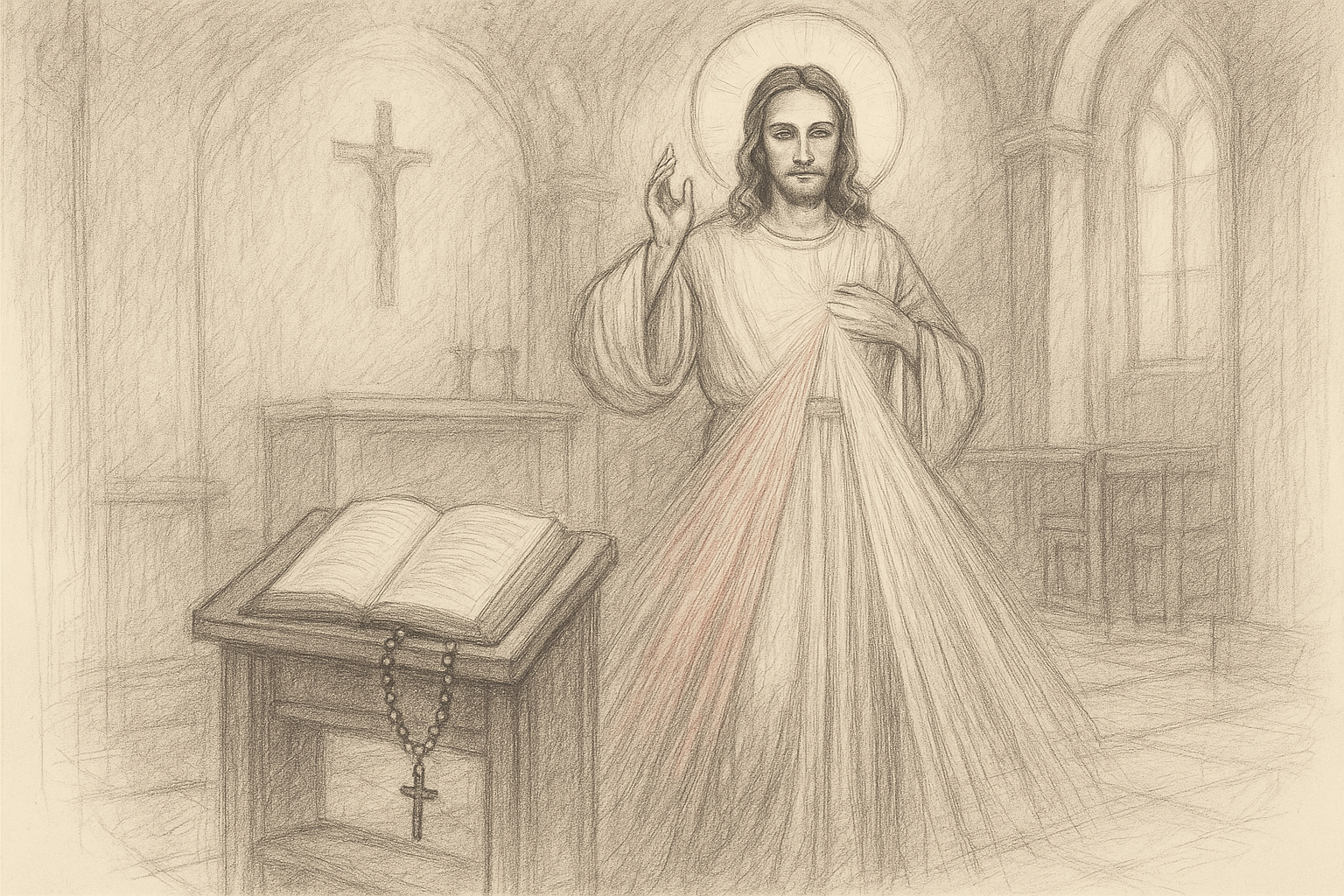
The image of Divine Mercy, with Christ raising one hand in blessing and the other pointing to his Heart from which two rays stream forth, has become familiar across the Catholic world. The image is not magical. Its purpose is catechetical and devotional. It reminds the faithful of the mercy flowing from the pierced Heart of Jesus.
The red and pale rays are commonly understood as symbolizing the Blood and Water that flowed from Christ's side on the Cross, signs long associated with the sacraments and the life of grace. The image points the viewer to the Paschal Mystery and invites a response of trust. It is not meant to replace doctrine, but to make doctrine prayerful and accessible.
For families, churches, and individuals, the image can serve as a quiet reminder that Christ sees human weakness without contempt. He does not excuse sin, but he does not turn away from sinners who come to him. That is a message worth placing before the eyes of the household.
How an Ordinary Catholic Can Live the Devotion
Many people assume devotion must be elaborate to be sincere. The opposite is often true. Divine Mercy is most authentic when it becomes ordinary, patient, and consistent.
1. Begin with trust
Trust is not naive optimism. It is an act of faith. A Catholic who lives Divine Mercy begins each day by placing fears, plans, failures, and loved ones in the hands of Christ. A brief prayer can suffice: Jesus, I trust in You. Repeated often, it can reshape the interior life.
2. Go to Confession regularly
Nothing about Divine Mercy makes the sacrament of Reconciliation less necessary. It makes it more necessary and more beautiful. Regular Confession sharpens conscience, strengthens humility, and lets mercy heal real wounds. Many Catholics discover that once they return to Confession, the devotion becomes less sentimental and more life-giving.
3. Pray for the dying and for sinners
One of the most traditional movements of the devotion is intercession for those in greatest need of mercy. This can be as simple as praying the Chaplet for a dying relative, an estranged family member, a troubled neighbor, or anyone whose life seems far from God. Such prayer broadens the heart.
4. Practice mercy in speech and action
Mercy can be lived in ordinary conversations. It can mean refusing gossip, speaking gently, forgiving a small offense, listening well, or helping someone who cannot repay you. It can also mean the corporal and spiritual works of mercy, which remain essential Catholic practices. The devotion becomes credible when it changes how we treat people.
5. Unite suffering to Christ
Many Catholics pray Divine Mercy when life is hard. This is fitting. Suffering offered in union with Christ is not wasted. When sickness, disappointment, grief, or fatigue arrive, the soul can learn to say, in faith, that even this belongs to the Lord. Mercy does not always remove the cross. It gives the cross meaning in Christ.
Why the Devotion Matters Now
Our age knows both public cruelty and private exhaustion. Many people are weary of judgment from others and suspicious of any claim that sounds too demanding. Others are crushed by guilt and wonder whether God could truly forgive them. The Divine Mercy devotion speaks to both groups without contradiction.
It says to the proud that no one is beyond repentance. It says to the ashamed that no one is beyond forgiveness. It says to the faithful that holiness is not achieved by self-reliance but received through grace. In that sense, the devotion is profoundly Catholic because it keeps together sin, mercy, repentance, sacrament, and mission.
For Catholics trying to live the faith with honesty, Divine Mercy can become a steady anchor. It reminds us that Christ is not distant from human misery. He entered it, carried it, redeemed it, and now pours out mercy through his Church. The more deeply a believer receives that mercy, the more naturally it begins to flow outward to family, parish, and neighbor.
And that is perhaps the quiet test of authentic devotion: whether mercy has moved from our lips into our habits, from our prayer into our relationships, and from our private hope into the way we live before God and one another.
Keep Reading on Lets Read The Bible
Frequently Asked Questions
Is the Divine Mercy devotion required for Catholics?
No. It is a private devotion approved and encouraged by the Church, but not required in the way the sacraments are. Catholics are free to embrace it as a fruitful help to prayer and conversion.
How is the Chaplet of Divine Mercy different from the rosary?
The Chaplet is a separate prayer that is often prayed on rosary beads, but it has its own words and structure. It focuses on offering Christ's sacrifice to the Father and interceding for the world.
What is the best way to live the Divine Mercy devotion daily?
A simple pattern works well: trust Jesus, pray for sinners, go to Confession regularly, receive the Eucharist reverently, and practice concrete works of mercy toward others.