Church History
Peter in the Storms of the Early Church
How the fisherman from Galilee became the first witness of the Church's unity, courage, and missionary reach
Site Admin | December 19, 2025 | 73 views
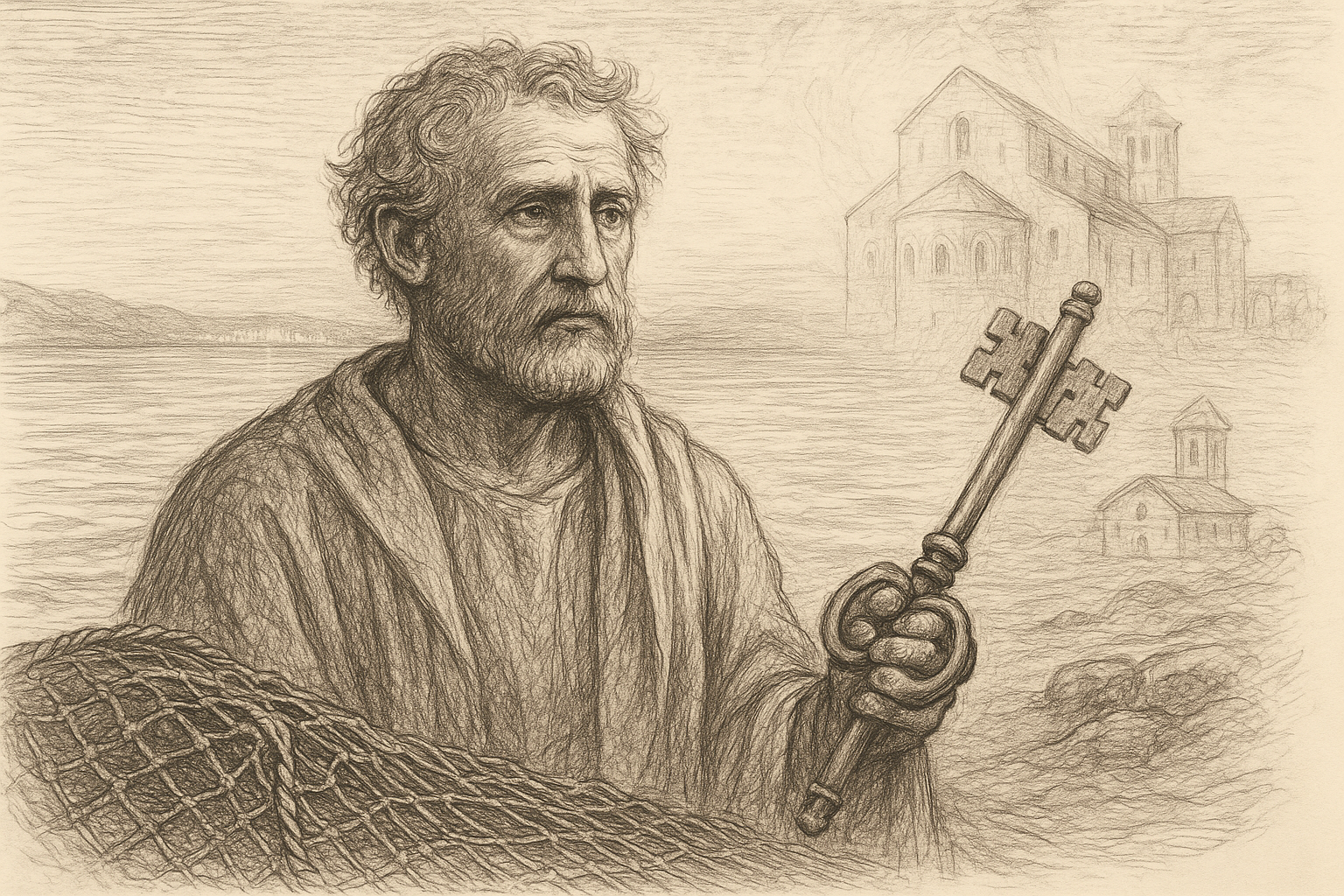
St. Peter history begins in the ordinary world of first century Galilee, not in a palace or a school of power. He was Simon, son of Jonah, a fisherman from Bethsaida and later a resident of Capernaum, a working man shaped by nets, weather, debt, and the hard discipline of daily labor. Into that world came Jesus of Nazareth, who did not merely call Peter to admire Him from a distance. He named him, formed him, corrected him, and placed him among the Twelve as a chief witness of the kingdom of God.
For Catholics, Peter is never just a historical figure. He is an apostle, a martyr, and the first to hold a unique pastoral office in the Church. Yet his greatness is striking precisely because it was not the greatness of natural strength. The Gospels present a man who speaks quickly, acts boldly, and fails painfully. Christ does not ignore those weaknesses. He heals and redirects them for the good of the whole Church.
The world Peter came from
Peter lived under Roman rule in a land where political power was distant, religious life was intense, and Jewish hopes for deliverance were alive. Galilee had its own mixture of cultures and pressures. It was a region where commerce moved through villages and along the Sea of Galilee, where taxes were felt deeply, and where ordinary people lived close to both poverty and religious expectation.
That setting matters for St. Peter history because it shows how far the Lord's choice reached. Jesus did not recruit Peter from a center of prestige. He called him from work. He called him in the middle of life. The fisherman becomes a disciple, and then the disciple becomes a shepherd. The Church's beginning is therefore rooted in grace, not human strategy.
Peter's first recorded encounter with Jesus is rich with meaning. In the Gospel of John, Andrew brings Simon to Christ, and Jesus gives him a new name: Cephas, meaning Rock Cephas. In the ancient world, a name given by one with authority signaled a mission. The new name pointed ahead to a future task that Peter did not yet fully understand.
Called to lead, yet still learning
Peter is shown throughout the Gospels as both eager and unfinished. He walks on water and then sinks. He confesses Jesus as the Messiah and then resists the prediction of the Passion. He promises fidelity and later denies the Lord three times. Each episode reveals something important about apostolic leadership. The man chosen to strengthen others is not one who never falls, but one who learns to rely on mercy.
When Jesus asks the Twelve who they say He is, Peter answers with a confession of faith: You are the Christ, the Son of the living God You are the Christ. Jesus blesses that confession and speaks of building His Church upon the rock On this rock I will build my Church. He also gives Peter the keys of the kingdom and a mandate to bind and loose I will give you the keys. Catholics have long seen in this passage the biblical foundation for Peter's pastoral primacy.
That primacy is not a claim that Peter was perfect or above correction. The New Testament is honest about his weakness. At Antioch, Paul rebukes Peter over conduct that risked confusing the truth of the Gospel Paul rebukes Peter. The episode is important because it shows both Peter's real authority and the seriousness of apostolic responsibility. The office serves the truth; it does not replace it.
The Paschal turning point
The events surrounding the Passion are central to St. Peter history. On the night Jesus was betrayed, Peter swore loyalty, then failed under pressure in the high priest's courtyard. The cockcrow became a bitter sign of his human frailty The Lord turned and looked at Peter. But the story does not end in shame.
After the Resurrection, the risen Christ meets Peter by the Sea of Tiberias. There, Jesus asks him three times, Do you love me?, and each answer becomes a commission: Feed my lambs, Tend my sheep, Feed my sheep Feed my lambs. This scene is one of the most moving in the New Testament because it joins restoration and mission. Peter is not merely forgiven. He is entrusted again with pastoral care.
The pattern matters for Catholics today. Leadership in the Church is not a reward for flawless performance. It is a service purified by repentance and sustained by grace. Peter's tears after his denial and his later courage in proclaiming Christ both belong to the same vocation.
Pentecost and the public birth of witness
The Book of Acts presents Peter as the visible spokesman of the apostolic college at decisive moments. At Pentecost, he stands with the Eleven and preaches to the crowds gathered in Jerusalem Peter stands with the Eleven. He interprets the events in the light of the prophets, announces the death and Resurrection of Jesus, and calls hearers to repent and be baptized Repent and be baptized.
This is one of the great milestones in St. Peter history. The fisherman who once feared a servant girl now speaks before the city that condemned his Master. The transformation is not psychological confidence alone. It is the result of the Holy Spirit. Peter's boldness is apostolic, not personal in the merely worldly sense.
Acts also shows Peter opening doors the Church had not yet fully crossed. He heals in Christ's name, confronts deceit in the case of Ananias and Sapphira, and receives the Spirit's prompting to welcome Gentiles into the Church through the conversion of Cornelius Peter and Cornelius. That moment is historically and theologically important. It marks a decisive step in the universal mission of the Gospel, showing that God's mercy is not confined to one people by ethnicity or custom.
Jerusalem, Antioch, and the shape of apostolic authority
Peter's leadership unfolded in a Church still learning what it meant to be catholic, that is, universal. The first Christians remained rooted in Jerusalem at the beginning, but persecution, preaching, and mission carried the Gospel outward. Peter appears in that developing Church as a unifying figure, especially in matters touching doctrine and communion.
The Council of Jerusalem, described in Acts 15, shows the apostles and elders wrestling with whether Gentile believers must keep the whole Mosaic law. Peter speaks first in the assembly and recalls how God had already given the Holy Spirit to Gentiles apart from the ceremonial burden being proposed Peter at the Council. His intervention helps clarify that salvation is by grace and not by the full yoke of the law.
For Catholic readers, this is a window into the early exercise of Petrine service. The Church does not invent truth by vote, nor does it set aside revelation to follow convenience. She discerns, prays, debates, and finally speaks with apostolic authority for the sake of unity in the faith.
Antioch also belongs in this history. There, Peter's conduct became the occasion for Paul's correction Paul rebukes Peter. The fact that this moment was preserved in Scripture is itself instructive. The Church does not hide the difficulties of her first leaders. Instead, she shows that divine governance works through real human history, with its tensions, misunderstandings, and necessary clarifications.
Rome and the final witness
By the time the New Testament and early Christian memory converge on Peter's final years, Rome stands at the center of his martyrdom. The tradition that Peter ended his life in Rome is deeply rooted in the earliest Christian witness. Catholic faith sees in that tradition the providential link between Peter and the Roman See, a link that would shape the Church's visible center of unity through the centuries.
Scripture itself points toward Peter's martyrdom in the Lord's words about old age and the manner in which he would glorify God You will stretch out your hands. Peter's death, by tradition under Nero's persecution, is not recorded in the New Testament narrative itself, but it belongs to the Church's ancient memory and to the logic of his vocation. The shepherd who once trembled now gives his life for Christ.
His tomb near the Vatican Hill became a place of Christian remembrance, testimony, and prayer. Later generations associated his burial with the basilica built over it, but the essential point for the Church is theological before it is architectural. Peter's witness did not end in administrative office. It ended in martyrdom. He sealed the faith he had confessed at Caesarea Philippi with his blood.
What Peter reveals about the papacy
To speak about St. Peter history is also to speak about the meaning of the papacy. Catholics do not believe the pope is a replacement for Christ. Christ remains the true head of the Church. The Petrine office serves as a visible sign of unity, a safeguard for apostolic faith, and a pastoral ministry ordered to the good of the whole Body of Christ.
Peter's life helps clarify that this office is biblical, historical, and pastoral. It is biblical because Christ gives him the keys and commands him to strengthen his brethren Strengthen your brethren. It is historical because Peter appears as leader among the apostles in Acts and in the early Church's memory. It is pastoral because the chief task is not self-display but feeding the flock.
Modern Catholics can easily forget that authority in the Church is meant for service. Peter reminds us that true leadership is marked by confession of Christ, obedience to grace, and willingness to suffer for the flock. The Church does not seek leaders who are brilliant in a worldly sense but leaders who belong to Jesus Christ.
Lessons for Catholics today
Peter's witness remains close to the daily life of believers because he embodies a very human path to holiness. A few lessons stand out plainly.
- Christ calls real people. Peter was not ideal material by worldly standards. He was called from work, formed in weakness, and made fruitful by grace.
- Failure is not the end. Peter's denial was grave, but mercy had the last word. Repentance became the doorway to renewed mission.
- Faith must become witness. Peter did not keep his confession private. He preached, baptized, healed, and led.
- Unity is precious. Peter's role in the early Church shows that communion is not optional. It is part of Christ's plan.
- Authority is for service. Whether in the apostolic age or now, leadership in the Church exists to feed and guard the people of God.
Peter also teaches patience. The apostle who once acted before he thought was gradually shaped into a steady witness. That kind of formation may be slow, but it is deeply Christian. Grace does not erase personality. It perfects it.
In praying with St. Peter, Catholics can ask for honesty about their own weakness and courage in following Christ more closely. The man who once sank in fear and later stood firm in martyrdom shows that the Lord can build a rock from the dust of a fisherman. That is part of the enduring beauty of St. Peter history, and it is why his memory still carries the weight of the Church's hope.
Keep Reading on Lets Read The Bible
Frequently Asked Questions
Why is St. Peter so important in Catholic history?
St. Peter is important because Christ gave him a unique pastoral role among the apostles. In Scripture, Peter receives the keys of the kingdom, strengthens his brethren, and helps guide the early Church through major questions of faith and mission.
Did St. Peter really lead the early Church in Rome?
Catholic tradition firmly holds that Peter ended his ministry and suffered martyrdom in Rome. That ancient witness is central to the Church's understanding of the Roman See as linked to Peter's pastoral mission.
What is the main lesson Catholics should take from Peter's life?
Peter shows that Christ builds the Church through converted weakness. His failures, repentance, preaching, and martyrdom all teach Catholics that fidelity depends on grace, humility, and perseverance.