Church History
Pius XII and the Difficult Art of Sheer Fidelity
In a century marked by war, ideology, and moral confusion, Pope Pius XII stands as a study in restraint, vigilance, and the steady work of guarding the Church.
Site Admin | January 7, 2026 | 69 views
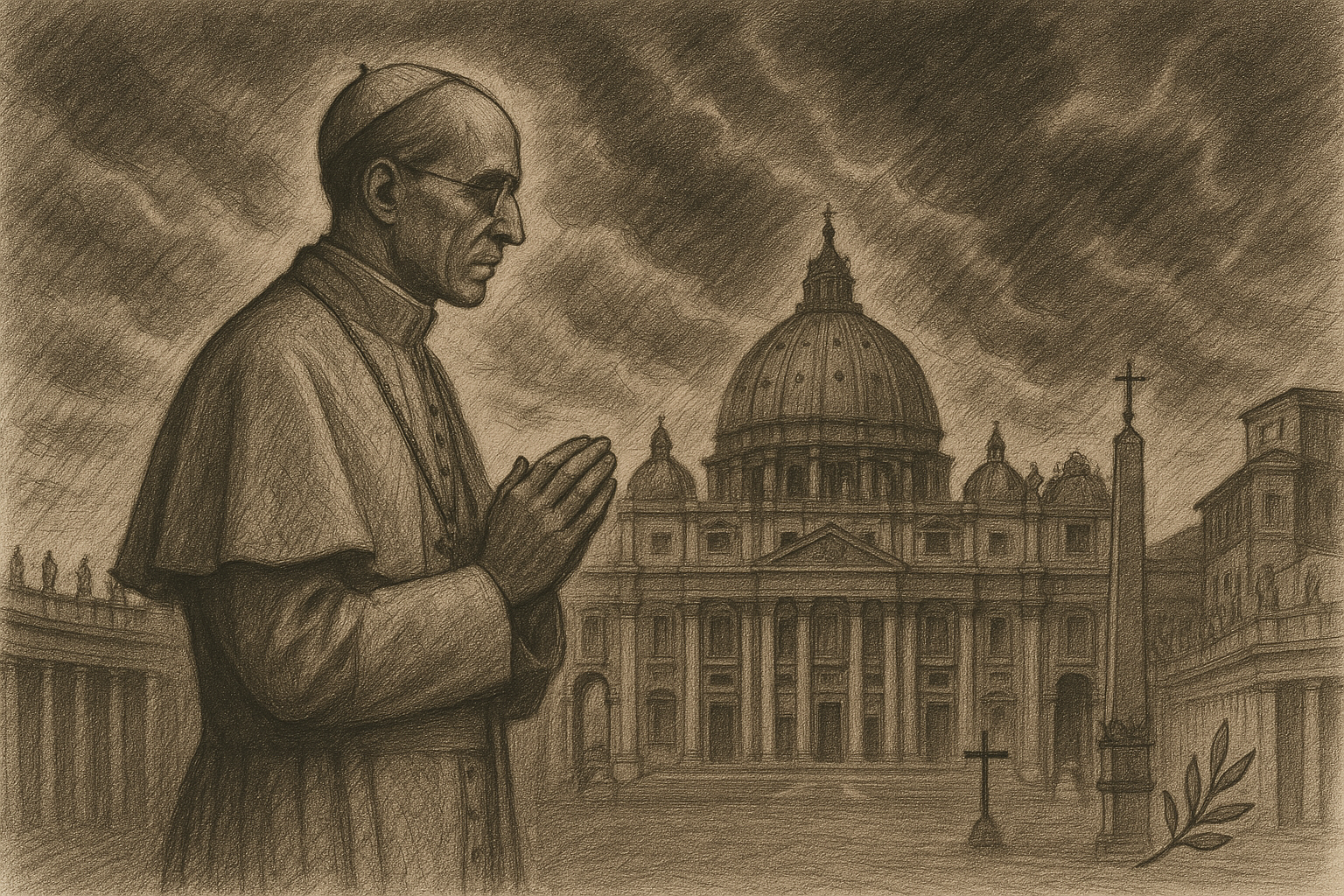
Pope Pius XII remains one of the most discussed popes of the twentieth century because his pontificate unfolded under conditions that tested every form of Catholic leadership. He served the Church during the rise of totalitarian regimes, the Second World War, the early Cold War, and a world increasingly shaped by technological change and moral instability. To study him is to study the challenge of governing the Church when history itself seems to be breaking apart.
That is why Pope Pius XII Catholic history still matters. His life does not offer an easy slogan or a tidy partisan lesson. Instead, it offers a serious picture of a pope trying to preserve the Church's freedom, protect the faithful, and speak with moral clarity in an age when public speech could easily be twisted, ignored, or punished. Catholics today can learn much from that combination of courage, restraint, and responsibility.
A Pope Formed by Diplomacy and Crisis
Eugenio Pacelli, the future Pius XII, was not formed first as a public figure but as a priest and diplomat. He served the Holy See in delicate assignments and knew from experience how fragile the Church's position could be in a hostile political world. That background shaped his pontificate in decisive ways. When he was elected pope in 1939, Europe was already on the edge of catastrophe.
His early years as pope were marked by the outbreak of war and by the collapse of political norms that had once seemed stable. Whole populations were displaced. The dignity of the human person was trampled by aggressive nationalism, racial ideology, and state power. In such a setting, a pope could not simply speak as though he were addressing a quiet academic debate. He had to guard lives, protect communications, and preserve the Church's ability to act wherever possible.
It is important to remember that the Church never asks her shepherds to become worldly strategists for their own sake. Yet a pope must often exercise prudence in ways that are not immediately visible. The public may see only what is said in a speech or written in a document, but a pope must also consider what happens to Christians in prisons, convents, dioceses, and occupied lands when words are broadcast into violent circumstances.
What Pius XII Tried to Protect
Pius XII's wartime pontificate is often discussed in terms of what he said and what he did not say publicly. That debate will continue because historians examine evidence differently and because the period itself was morally tangled. Still, any fair reading must begin with the fact that he labored to preserve the Church's humanitarian capacity during immense danger. Catholic institutions helped shelter refugees, assisted the displaced, and provided material and spiritual support in many places where open resistance could have brought severe retaliation.
He also used radio, diplomatic channels, and papal statements to defend moral truths about peace, the dignity of the person, and the sanctity of life. In his 1939 Christmas address, he warned against a world without moral foundations and recalled the rights owed to the human person. His concern was not abstract. It was rooted in a conviction that when societies sever law from truth, the weak are the first to suffer.
Defend the weak and the fatherless; rescue the poor and the needy.
That biblical charge helps illuminate the moral atmosphere of his pontificate. A pope is not merely a commentator on current events. He is a shepherd who must defend those most likely to be overlooked when power becomes ruthless. Pius XII believed that duty remained even when the cost of speaking was severe.
Doctrine, Liturgy, and the Interior Life of the Church
Pius XII was not only a wartime pope. He also helped guide the Church's doctrinal and liturgical life. His encyclical Humani Generis addressed theological confusion and warned against ideas that weakened the stability of Catholic teaching. He was deeply concerned that the faith be handed on intact, not dissolved into the spirit of the age.
He also had a significant role in liturgical renewal. His reforms to the Easter Vigil, for example, were an important step in renewing Catholic worship and preparing the way for later developments. He wanted the faithful to encounter the Church's prayer more fully and more fruitfully. This concern was not about novelty for its own sake. It was about helping the liturgy speak more clearly to the spiritual life of ordinary Catholics.
At the same time, he insisted that the Church's worship and teaching must remain anchored in truth. That balance is easy to lose in any era. Some people want doctrine without pastoral care. Others want pastoral care without doctrine. Pius XII's pontificate reminds us that the Church cannot survive by choosing between them. She must hold both together.
The Church as Teacher and Mother
One reason Pius XII still matters is that he understood the Church as more than a political voice. She is a mother who nourishes souls and a teacher who safeguards revealed truth. A pope who forgets either role weakens his office. Pius XII tried, imperfectly like every human leader, to preserve both.
For Catholics today, this matters because the temptation to separate compassion from conviction is always present. We may be tempted to reduce the faith to public image management, or to treat the Church as one more institution competing for approval. Pius XII's era shows how dangerous that can be. When the Church is pressured to become merely useful or merely acceptable, she risks losing the freedom to be herself.
The Weight of Silence and the Demands of Prudence
No serious discussion of Pius XII can avoid the question of silence. Critics have argued that he did not speak forcefully enough or publicly enough against the horrors unfolding around him. Supporters have pointed to the constraints of the time, the danger of worsening reprisals, and the aid provided through discreet channels. Catholics should not dismiss these questions, because moral leadership in a crisis always deserves scrutiny.
Yet the question should be approached with humility. Prudence is not cowardice. It is the virtue that helps a person choose the right means toward a good end. In wartime and under occupation, a public declaration could save lives in one place and endanger them in another. That does not solve every tension, but it does mean the historical judgment must be careful rather than glib.
Scripture repeatedly shows that God's people must act wisely as well as boldly. Jesus tells his disciples to be wise as serpents and innocent as doves. That is a difficult command in peacetime, and harder still in a world where every word can be used as a weapon. Pius XII's pontificate invites Catholics to think about that tension seriously instead of reducing it to slogans.
His Lasting Lesson for Catholics
If Pius XII matters now, it is because he shows what faithfulness looks like when the Church cannot rely on social comfort. He was not a charismatic reformer in the modern sense. He was not a man of grand public theater. He was a pope of discipline, caution, and intense responsibility. Those traits can seem unremarkable until history turns harsh. Then they become essential.
There are at least three lessons Catholics can draw from his example.
- First, the Church must never sacrifice truth for convenience. Pius XII defended doctrinal clarity because he knew confusion weakens souls.
- Second, prudence is a moral virtue, not an excuse. Wise action may be quiet, indirect, or difficult to explain, but it is still action shaped by charity and truth.
- Third, the Church's mission is spiritual before it is political. Catholic institutions can serve the common good precisely because they answer first to Christ, not to shifting ideologies.
His pontificate also reminds Catholics to be cautious about judging the past by the assumptions of the present. It is easy to demand obviousness from a previous age while forgetting the fear, censorship, and violence that shaped it. Historical fairness does not mean avoiding criticism. It means refusing to simplify a complicated reality.
There is another lesson too. Pius XII trusted that the Church's deepest strength would not come from public spectacle but from fidelity in hidden places. That conviction still speaks to Catholics who live ordinary lives. Most believers will never command armies, negotiate treaties, or be studied by historians. Yet they are still called to defend the faith in families, parishes, classrooms, and workplaces through steady integrity.
That verse captures something essential about the kind of maturity Pius XII had to exercise. He could not solve every tragedy. No pope can. But he could keep the Church pointed toward justice, mercy, and humility even when the world around him rewarded neither. That is part of why he remains worth reading, debating, and remembering.
To revisit Pius XII is not to pretend the twentieth century was simple or that every decision was perfect. It is to recognize that the papacy often carries a burden heavier than modern imagination allows. In a century of terror and change, he tried to keep the Church standing, praying, teaching, and serving. That work was not flashy, but it was real, and Catholics still live from the fruits of such hidden fidelity.
Keep Reading on Lets Read The Bible
Frequently Asked Questions
Why is Pope Pius XII still controversial among historians?
Because his pontificate took place during World War II and the Holocaust, and historians continue to debate how to interpret his public statements, private diplomacy, and wartime prudence.
What are some major contributions of Pius XII to the Catholic Church?
He defended doctrinal clarity, promoted liturgical renewal, and used diplomacy and humanitarian channels to support the Church during a period of war and political upheaval.
What can Catholics learn from Pope Pius XII today?
They can learn the value of prudence, fidelity to doctrine, care for the vulnerable, and the importance of serving the Church faithfully even when the surrounding culture is unstable.