Prayer and Devotion
Praying the Psalms When Words Are Hard to Find
How the Church's ancient prayer book can steady the heart, shape the soul, and give voice to faith in every season
Site Admin | December 9, 2025 | 84 views
The Psalms have a way of speaking when our own speech falters. In moments of joy, they give us praise. In grief, they give us lament. In uncertainty, they give us trust. For Catholics, praying with the Psalms is not merely an old devotional custom. It is a living way of entering the prayer of Israel, the prayer of Christ, and the prayer of the Church.
When someone looks for a praying with the Psalms Catholic guide, the real question is often simple: How do I begin? The answer is more ordinary than many people expect. You begin by opening the Bible, reading slowly, and letting the words become your own. The Psalms were given not only to be studied but to be prayed. They teach us how to stand before God honestly, reverently, and with hope.
Why the Psalms belong so naturally to Catholic prayer
The Psalms are woven through Scripture, liturgy, and the daily prayer of the Church. They appear again and again in the Mass, in the Liturgy of the Hours, in the responses of the assembly, and in the private prayer of believers. This is not accidental. The Psalms express the full range of the human heart before God, and the Church knows that the heart must sometimes learn to pray before it can explain itself.
Jesus prayed the Psalms. On the Cross, He gave voice to the opening words of Psalm 22: My God, my God, why have you forsaken me?. His prayer reveals both the depth of suffering and the confidence that suffering is not the final word. When Catholics pray the Psalms, they are not borrowing someone else's words in a merely literary sense. They are entering a prayer that Christ Himself used, fulfilled, and entrusted to the Church.
That matters because Catholic prayer is never only about personal expression. It is also about communion. The Psalms teach us to pray with the Body of Christ across time. A believer in sorrow, a monk in choir, a family at evening prayer, and a priest at the altar can all be standing in the same stream of worship.
What it means to pray a Psalm, not just read it
There is a difference between reading a Psalm for information and praying it with faith. Reading asks, What does this say? Praying asks, Lord, what are You saying to me through this? The second approach is slower, more receptive, and often more fruitful.
To pray a Psalm is to let its words become a conversation. You may begin by noticing one line that seems to glow. You might pause there, repeat it, and speak to God from it. If the Psalm says, The Lord is my shepherd; I shall not want, you can pray: Lord, You know what I lack. Shepherd me in this decision, this sadness, this work, this family concern. The inspired text becomes a doorway into living prayer.
This also means allowing the hard lines of the Psalms to remain hard. Some Psalms are gentle and bright. Others are raw with grief, anger, or confusion. Catholics do not need to pretend those feelings are not real. Instead, we bring them into the light of God. The Psalms give us language that is truthful without becoming self-absorbed, and reverent without becoming cold.
Why the Psalms strengthen the spiritual life
Praying with the Psalms forms the soul in several ways. First, it teaches honesty before God. Many people learn to hide from the Lord when they are wounded, ashamed, or afraid. The Psalms teach the opposite. They show that the right place for sorrow is in prayer, not in isolation.
Second, the Psalms teach trust. Again and again, fear gives way to confidence in God's mercy. Consider the movement of Psalm 27: The Lord is my light and my salvation; whom should I fear?. This is not shallow optimism. It is a tested faith that remembers who God is when circumstances are still unresolved.
Third, the Psalms enlarge our prayer beyond immediate needs. They move us toward adoration, repentance, gratitude, and praise. That is especially helpful when prayer becomes repetitive or dry. The Psalms keep us from reducing prayer to a wish list. They train us to adore God for who He is.
Finally, the Psalms prepare us for suffering. Catholic spirituality never promises that life will be free of trials. It promises that grace will meet us there. The Psalms do not deny pain, but they refuse to let pain have the last word. They place tears within the horizon of hope.
How to begin if you have never prayed the Psalms
If the Psalms feel intimidating at first, start simply. You do not need a complex method. A few quiet minutes can be enough. The key is regularity, not performance.
- Choose one Psalm. Begin with a short and familiar Psalm such as Psalm 23, 27, 63, 100, or 139.
- Read it slowly. Notice repeated words, surprising phrases, or anything that stirs your heart.
- Pause at one line. Repeat it quietly. Let it settle into your mind and memory.
- Speak to God honestly. Turn the Psalm into prayer. Thank Him, praise Him, ask for help, or simply remain with Him in silence.
- End with a familiar prayer. An Our Father, a Glory Be, or a brief act of trust can close the time well.
You might also keep a small notebook nearby. Write down one verse that stayed with you and one short response to God. Over time, you may notice that certain Psalms become companions in particular situations. Some texts return in illness, others in gratitude, others in temptation or distress.
A gentle method for busy days
If your schedule is crowded, pray one Psalm verse by verse while traveling, waiting, or before bed. You do not need a long block of time to begin. Even one or two lines, prayed attentively, can open the heart. A line like Be still and know that I am God can become a quiet anchor in a restless day.
How the Psalms deepen when prayed with the Church
Catholics are never praying alone, even when they are alone. The Psalms are the Church's prayer book, and they reach their fullest expression in communal worship. At Mass, the responsorial Psalm lets the assembly answer God's Word with God's own inspired prayer. In the Liturgy of the Hours, the Psalms shape the daily rhythm of praise, supplication, and remembrance.
This communal dimension matters because the Psalms teach us that prayer is not private in the narrow sense. We do bring our own needs, and we do speak from our own lives. Yet we do so as members of a people redeemed by grace. The Psalms help purify individual devotion by joining it to the worship of the Church.
They also help us listen. When a Psalm is prayed in the liturgy, we are not choosing only the lines we prefer. We receive the whole prayer, including the lines that challenge us. This is spiritually healthy. The Church does not allow prayer to become a mirror for our preferences. She gives us a school of prayer that shapes us over time.
Praying the difficult Psalms
Some Catholics feel uncertain when they reach Psalms that contain imprecations, complaints, or sharp cries for justice. That unease is understandable. These Psalms should be approached with reverence and context. They are not invitations to personal revenge. Rather, they are expressions of human anguish brought before God instead of enacted in sin.
When a Psalm gives voice to outrage or grief, it can remind us that God is not offended by the truth. He can receive the burden of a wounded heart. In prayer, we are allowed to say, Lord, this is where I am. Help me not to remain here. Over time, the act of placing our pain before God begins to purify it.
It is also wise to read difficult Psalms in light of Christ and the Church. Jesus transforms every human cry by entering fully into suffering and redeeming it. What cannot be prayed safely as a demand for personal vengeance can often be offered as a plea for justice, conversion, mercy, or deliverance from evil.
Ways to make the Psalms part of everyday Catholic life
Habits grow through repetition. If you want the Psalms to shape your spiritual life, let them become part of ordinary moments rather than an ideal you postpone.
- Pray a Psalm in the morning before checking your phone.
- Use one Psalm line as a prayer before work or study.
- Read a Psalm aloud with family at night.
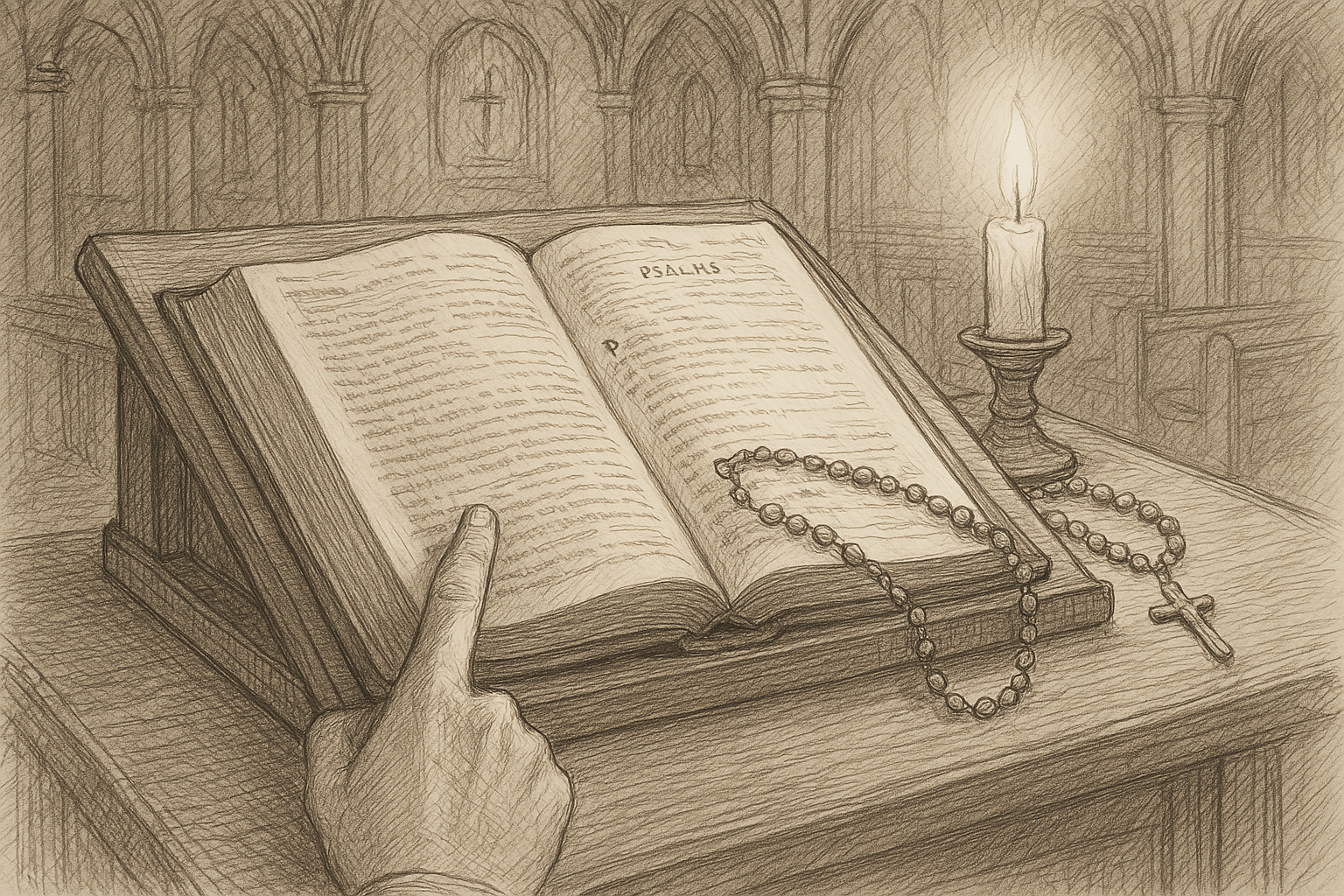
- Keep a favorite Psalm near your Rosary or Bible.
- Return to one Psalm during seasons of stress, grief, or discernment.
Some people find it helpful to pair the Psalms with other devotions. A Psalm can prepare the heart for the Rosary, follow a Holy Hour, or accompany a moment of Eucharistic thanksgiving. The Psalms are flexible in that way. They do not compete with Catholic prayer life. They enrich it.
It may also help to pray the same Psalm more than once. Familiarity is not the enemy of prayer. Often the opposite is true. When a Psalm becomes known, its words begin to go deeper. What once seemed distant starts to sound like your own life spoken before God.
Letting the Psalms teach you how to hope
One of the greatest gifts of the Psalms is that they teach hope without denial. They do not pretend the world is easy, but neither do they surrender to despair. They keep returning to God's faithfulness, even when the path is dark. That is a deeply Catholic instinct. Grace does not erase human weakness; it sustains us through it.
If prayer has felt dry, the Psalms may give you a way back in. If prayer has felt noisy, they may bring stillness. If prayer has felt like a duty, they may restore warmth. If prayer has felt impossible, they may offer words sturdy enough to carry you until your own heart can speak again.
And if all you can pray today is one line, that is enough to begin. The Psalms are patient. They have welcomed the sorrowful, the grateful, the restless, and the weary for generations. They can still do the same now, one honest prayer at a time.
Keep Reading on Lets Read The Bible
Frequently Asked Questions
Which Psalms are best for beginning Catholic prayer with the Psalms?
Many people start with Psalm 23, Psalm 27, Psalm 63, Psalm 100, or Psalm 139 because they are short, memorable, and rich in trust, praise, and longing for God.
Do Catholics need a special method to pray the Psalms?
No special method is required. Read slowly, notice a line that stands out, speak to God from it, and end with a simple prayer. The important thing is attentive, reverent prayer.
How do I pray Psalms that are harsh or difficult?
Read them in context, avoid turning them into personal resentment, and offer the emotions they express to God. Many difficult Psalms can be prayed as pleas for justice, mercy, or deliverance.