Jesus and the Gospels
A Quiet Feast, a First Sign: How Cana Opens the Heart of the Gospel
The Wedding at Cana shows Jesus as the generous Bridegroom, reveals Mary's steady faith, and teaches disciples how to notice grace in ordinary life.
Site Admin | January 31, 2026 | 79 views
The Wedding at Cana in the Gospel is one of the most familiar scenes in the New Testament, yet it keeps unfolding with new depth each time we return to it. A wedding feast is interrupted by a shortage of wine. Mary notices the need. Jesus responds. Water becomes wine, and the disciples begin to believe. In just a few verses, Saint John gives us a sign that is at once simple and immense.
John tells us that this took place on the third day, and that Jesus, His mother, and His disciples had been invited to the wedding feast in Cana of Galilee. The setting matters. Jesus does not begin His public ministry in a palace, a courtroom, or a temple court. He begins at a human celebration, among ordinary people, in the middle of a need that could become a quiet humiliation for the bridegroom and his household. The Lord enters a domestic scene and fills it with divine abundance.
The Gospel scene in its own setting
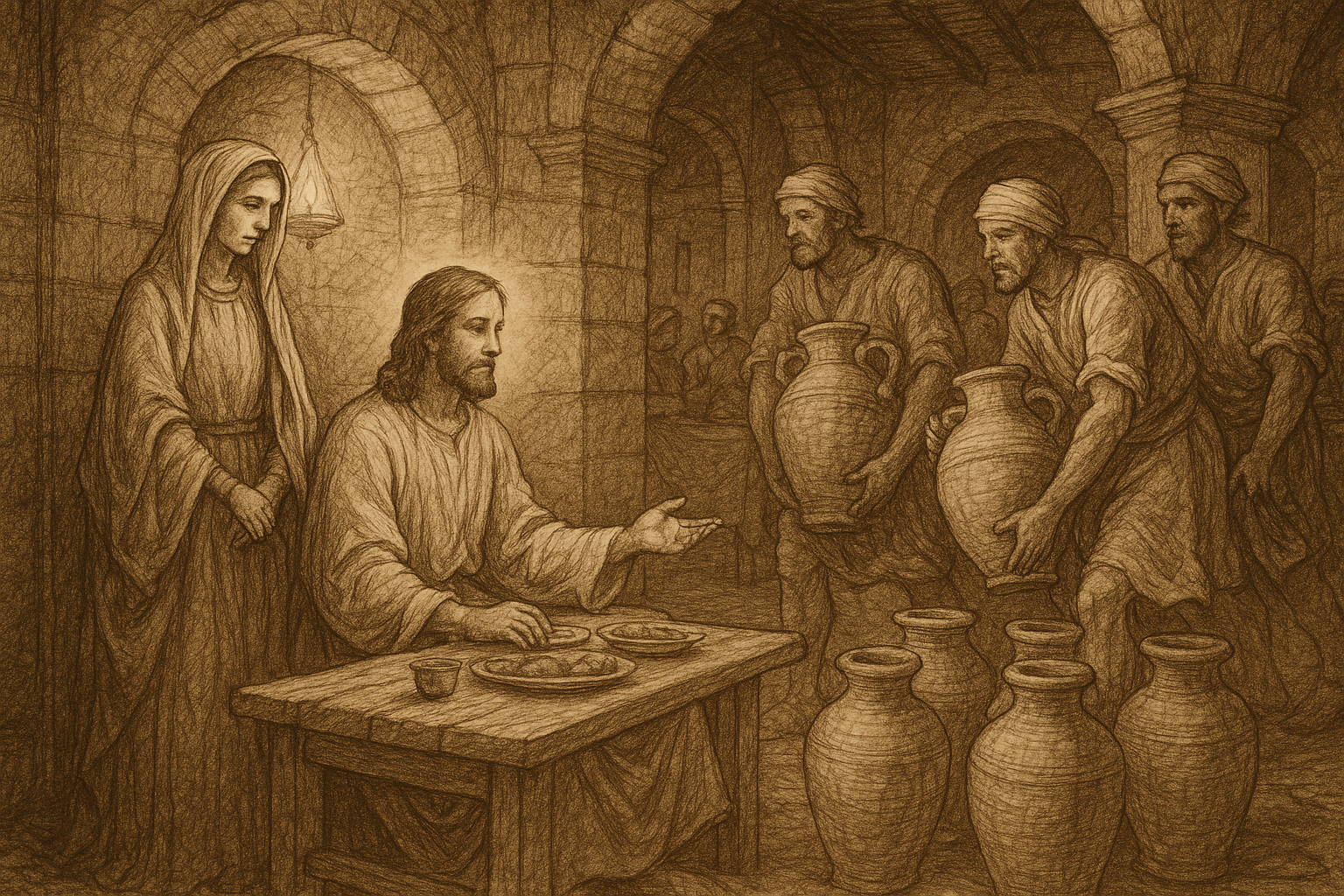
The account in John 2:1 to 11 is brief, but every detail carries weight. When the wine runs short, Mary turns to Jesus with a sentence that is both restrained and full of confidence: they have no wine. She does not tell Him what to do. She simply presents the need. In her words we hear the prayer of faith, the kind that notices lack without panic and brings it directly to the Lord.
Jesus replies, My hour has not yet come. This statement should not be read as a refusal in the ordinary sense. In John's Gospel, the hour points toward the whole saving mystery of Christ, especially His Passion, death, Resurrection, and glorification. Cana is therefore not a random miracle. It is an early sign that looks forward to the greater hour still to come. The sign at the wedding and the hour of the Cross belong together.
Mary then speaks the words that have echoed through Christian life ever since: Do whatever he tells you. In Catholic tradition, this is one of Mary's most luminous moments. She does not center herself. She directs attention to her Son. Her final recorded words in John's Gospel are a summons to obedience, and they remain a model for every disciple.
Do whatever he tells you.
That sentence is the spiritual center of the scene. It is also the pattern of Christian discipleship. Faith is not merely admiration from a distance. Faith listens, trusts, and obeys, even before the full meaning of the command is clear.
Why the miracle at Cana matters
Jesus instructs the servants to fill six stone water jars with water. These jars were used for Jewish ceremonial washings, and their presence quietly places the old order and the new side by side. The old containers are not discarded. They are transformed in service to something greater. This detail matters because John's Gospel often reveals fulfillment, not simple replacement. Christ does not come to erase God's earlier gifts. He comes to bring them to completion.
When the steward tastes the water now made wine, he is surprised by its quality. He tells the bridegroom that the good wine has been kept until now. This is more than a compliment on hospitality. It is a sign of the overflowing generosity of God. In Scripture, rich wine often suggests joy, blessing, and messianic abundance. At Cana, the kingdom of God appears not as scarcity but as superabundance. Christ does not merely prevent embarrassment. He reveals that His presence brings a deeper joy than the feast itself could produce.
Saint John closes the account by saying that Jesus manifested His glory, and His disciples believed in Him. That is the purpose of the sign. It is not only to solve a practical problem. It is to unveil who Jesus is. The miracle points beyond itself. It reveals the glory of the Son and invites a response of faith.
Mary's faith and her maternal role
Catholics have long reflected on the way Mary appears at Cana. She is attentive, calm, and confident in her Son. She is also maternal in a deeply biblical sense. She sees a need before anyone else speaks of it. She brings that need to Jesus. Then she guides the servants toward obedience. Mary is not a substitute for Christ. She is the one who leads others to Him.
Her role at Cana is often linked to her role throughout the Gospel. She receives the word of God in faith at the Annunciation, treasures and ponders the events of her Son's life, and remains steadfast when others falter. At Cana, that same hidden fidelity becomes visible in action. She acts not through spectacle, but through trust.
This is one reason the Wedding at Cana in the Gospel has such importance in Catholic devotion. Mary's intercession is never self-focused. She is always oriented toward Jesus. Her words remind us that authentic Marian devotion deepens discipleship instead of competing with it. We honor her best when we let her direct us to Christ.
A lesson in prayer
Mary's sentence, they have no wine, is a model of prayer that many believers can carry into daily life. Prayer does not need to be elaborate in order to be genuine. It can begin with a simple statement of need. Lord, there is no patience left. There is no peace in this home. There is no strength for this work. There is no wine.
Such prayer is not despairing when it is offered in faith. It is an act of confidence that Jesus can enter the shortage. Sometimes the answer comes immediately, and sometimes it does not. Yet Cana teaches that no real need is too small to place before the Lord, and no ordinary circumstance is outside His care.
The first sign and the larger Gospel pattern
In John's Gospel, signs are not merely wonders. They are acts that point to a deeper reality. Cana is the first sign, and so it functions almost like a doorway into the entire Gospel. At the wedding feast, Jesus reveals Himself as the giver of abundance, the sanctifier of human joy, and the one whose glory will later shine fully in His saving Passion.
The wedding setting also carries a rich biblical resonance. Throughout Scripture, the covenant between God and His people is often described with nuptial imagery. The Lord is faithful to His bride. Israel is called to covenant love. The prophets look forward to a renewed marriage bond between God and His people. In this light, the Wedding at Cana in the Gospel is not a decorative miracle. It is a sign that the Bridegroom has arrived.
Jesus does not attend the feast from a distance. He takes part in it, and by His presence He elevates it. This reveals something central to Catholic life: grace does not destroy what is human and good. It heals, perfects, and fulfills it. Marriage, family life, work, and shared celebration can all become places where Christ is welcomed and His glory made known.
Water, wine, and sacramental overtones
Catholic readers have often noticed sacramental echoes in the Cana account. The transformation of water into wine suggests the overflowing newness that Christ brings. The stone jars linked to ritual washing evoke purification. The abundance of excellent wine speaks of joy and covenant fulfillment. While the Gospel text does not reduce itself to one symbolic meaning, it naturally invites sacramental meditation.
It is fitting that Jesus begins His public signs in a setting of feast and transformation. The Church has always seen in Christ's action a hint of the mysteries He would later entrust to His Church. In particular, the scene encourages reverence for the sacraments as real encounters with divine grace, not empty symbols. The Lord who changed water into wine is the same Lord who continues to work through visible signs to communicate invisible life.
Practical lessons for discipleship
Cana is not only a beautiful story to admire. It is a school of Christian living. A few practical lessons stand out.
- Notice need early. Mary sees the shortage before the feast collapses. Disciples should learn to pay attention to the spiritual and practical needs around them.
- Bring the need to Jesus. The first movement in prayer is often not explanation but presentation. We place the shortage before the Lord and trust His wisdom.
- Obey promptly. The servants fill the jars before seeing the result. Faith often begins with humble action.
- Trust that Christ gives abundantly. Jesus does not simply provide enough. He gives wine of remarkable quality. God is not stingy with grace.
- Let Mary lead you to her Son. Her words remain a clear and gentle command for every generation: do whatever He tells you.
These lessons are especially important when faith feels ordinary or hidden. Most disciples spend most of their lives far from dramatic miracles. Yet Cana assures us that Christ is present in ordinary settings and real needs. He sees what others overlook. He blesses what seems insufficient. He transforms lack into praise.
What Cana asks of us now
The Gospel does not invite us to stand at Cana merely as spectators. It asks us to become participants. The feast becomes a question for the heart: where is the shortage in my life, and have I brought it to Jesus? Have I trusted His timing? Have I listened to Mary when she tells me to do whatever He tells me?
The answer will not always come in the form we expect. But the scene at Cana assures us that Christ is attentive, powerful, and generous. He sees the needs of a household. He honors a wedding. He strengthens the faith of His first disciples. And He still works in the quiet places where human hope runs short.
When we pray with the Wedding at Cana in the Gospel, we learn to expect grace in the midst of ordinary life. We learn that the Lord can transform what is lacking into something that serves joy. We learn that Mary's maternal care is tender and practical. And we learn, above all, that the first sign still points us toward the greater glory of Jesus Christ, who does not simply attend the feast, but gives the feast its true meaning.
Keep Reading on Lets Read The Bible
Frequently Asked Questions
Why is the Wedding at Cana important in John's Gospel?
It is the first of Jesus' signs in John's Gospel. At Cana, He reveals His glory, deepens the disciples' faith, and shows that His presence brings messianic joy and abundance.
What does Mary's instruction, Do whatever he tells you, mean for Catholics?
It shows Mary's maternal role as one who leads others to Jesus. For Catholics, it is a timeless call to trust Christ, obey His word, and let Mary guide us toward her Son.
How can the Wedding at Cana help in personal prayer?
Cana teaches believers to bring real needs to Jesus with simplicity and trust. It also encourages prompt obedience, patient faith, and confidence that Christ can transform lack into grace.