Sacraments and Liturgy
Receiving Mercy at the Church's Hour: A Catholic Look at Divine Mercy
A clear and prayerful guide to the devotion Jesus entrusted to St. Faustina, with its roots in Scripture, the sacraments, and the Church's life of mercy.
Site Admin | September 19, 2025 | 84 views
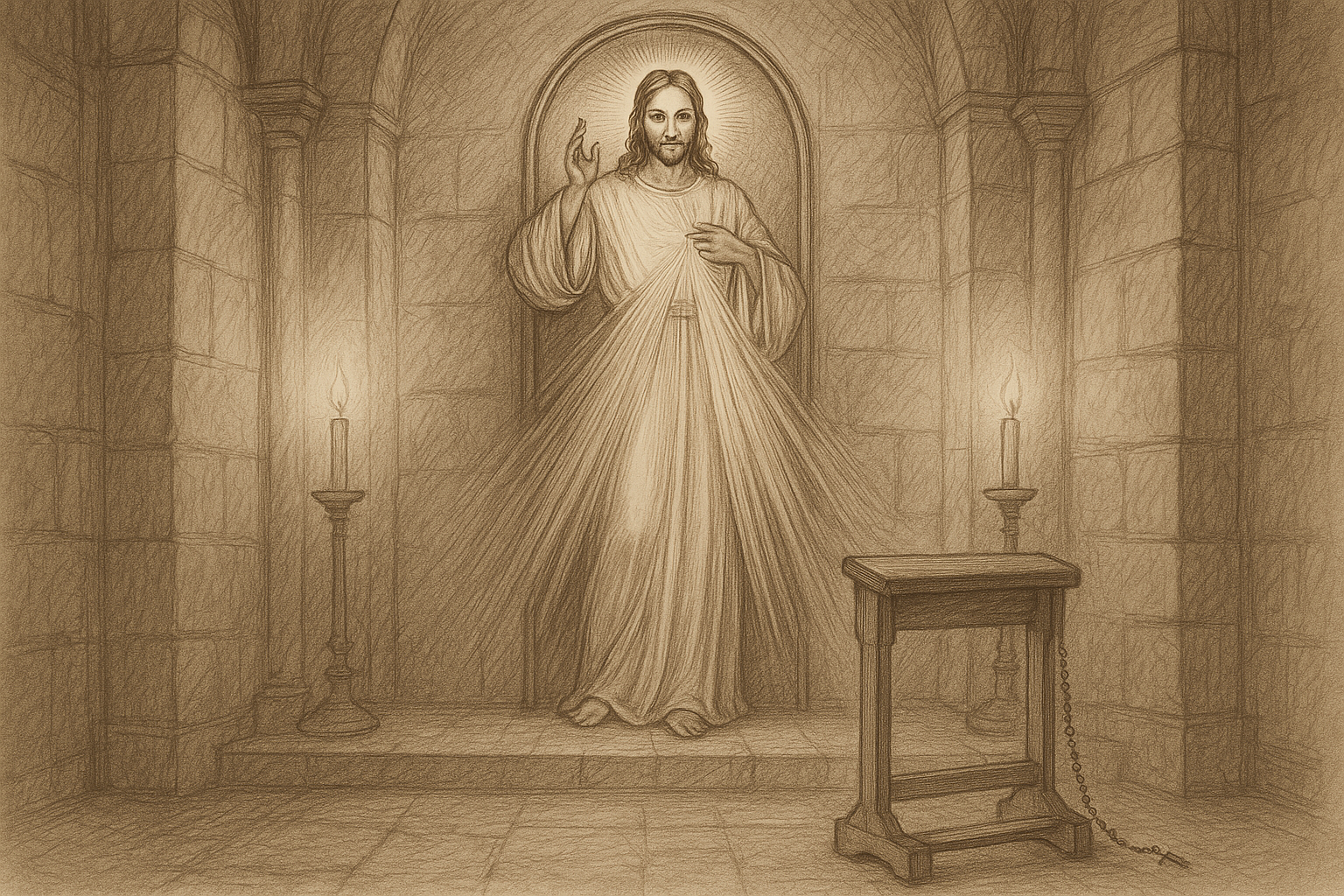
The Divine Mercy devotion has become familiar to many Catholics through the image of Christ with rays of red and pale light, the Chaplet of Divine Mercy, and the prayerful observance of the hour of Jesus' death. Yet the devotion is more than a set of popular practices. At its heart, it is a summons to trust in the mercy of God revealed in Jesus Christ and offered to the world through the Church.
For anyone seeking the Divine Mercy devotion explained in a calm and practical way, the first thing to see is this: it is not separate from the sacraments, and it is not meant to replace them. It leads the faithful back to Christ, especially in Confession, the Eucharist, prayer, and works of mercy. In that sense, it is deeply Catholic. It draws the soul toward the center of the Church's life, where mercy is not merely spoken about but actually received.
The heart of the devotion
The Divine Mercy devotion rests on a simple and profound truth: God does not tire of seeking sinners. The Gospel is full of this mercy. Jesus eats with tax collectors, forgives the repentant, heals the wounded, and restores those who have fallen far from God. His mercy is not weakness. It is love that enters human misery and transforms it.
St. Faustina Kowalska, a Polish nun of the Congregation of the Sisters of Our Lady of Mercy, recorded in her Diary the spiritual messages she said she received from Christ. Catholics receive her writings with devotion, while recognizing that private revelation does not belong to the deposit of faith. Even so, the Church has seen in the Divine Mercy message a strong reminder of what is already true in the Gospel: Christ desires that sinners trust Him and come to Him for forgiveness.
That trust is central. The devotion is often summed up in the simple prayer, Jesus, I trust in You. This is not a sentimental phrase. It is a surrender of fear, pride, and self-reliance. It is the posture of the soul that knows it cannot save itself and gladly receives salvation as gift.
Where the devotion came from
The modern devotion to Divine Mercy is closely associated with St. Faustina and with the image of Jesus that became known through her visions. In the image, Christ raises one hand in blessing while the other points toward His heart, from which red and pale rays flow. The image is tied to the words: Jesus, I trust in You.
The red and pale rays are commonly understood to symbolize the Blood and Water that flowed from the side of Christ on the Cross, a sign long read by the Church as pointing to the Eucharist and Baptism. The devotion thus reaches into the sacramental life of the Church rather than away from it. The Lord who gives mercy is the same Lord who gives His Body and Blood, forgives sins, and gathers His people into communion.
The devotional practices that grew around this message spread widely in the Church, especially after the call to mercy resonated with Catholics living through war, suffering, and moral confusion. But the appeal of Divine Mercy is not limited to one century. Every age needs to hear that Christ is willing to forgive, heal, and renew.
Mercy in Scripture and sacrament
The Divine Mercy devotion makes sense only when placed within the Bible and the sacramental life of the Church. Scripture already speaks with urgency about God's steadfast mercy. Psalm 51 is the cry of a repentant heart: Have mercy on me, O God. The prophet Isaiah speaks of the Lord who abundantly pardons: Let him return to the LORD, that he may have mercy. And in the Gospel, Jesus reveals the Father's heart in visible form, especially when He seeks out those who know they are needy.
At the center of the devotion stands the Cross. When the soldier pierces Jesus' side, blood and water flow. Catholics have long seen in that moment a sign of the sacraments and of the Church born from Christ's pierced heart. Divine Mercy devotion does not invent a new source of grace. It points again to the one source already given: the Savior who died and rose for us.
This is why the sacraments are so important to anyone who wants to live the devotion well. In Confession, mercy is personally received as absolution. In the Eucharist, the merciful Lord gives Himself as food for the journey. The devotion is healthiest when it leads to a life more deeply rooted in these realities. It is a mistake to think of it as a substitute for sacramental life, as though prayers alone could replace the grace Christ gives through His Church.
The Chaplet of Divine Mercy
The Chaplet of Divine Mercy is perhaps the best known prayer associated with the devotion. It is prayed on ordinary rosary beads, though it is distinct from the Rosary. Its petitions ask the Father to have mercy on the whole world for the sake of Jesus' sorrowful Passion.
The chaplet can be prayed at any time, but many Catholics make a habit of praying it at the Hour of Mercy, 3 p.m., the time associated with the death of Christ. That hour has become a spiritual pause in the day, a moment to remember the Cross and to plead for mercy for oneself, one's family, the Church, and the world.
Praying the chaplet faithfully does not require dramatic feelings. Like all Catholic prayer, it grows through regularity and humble attention. Some pray it with deep emotion. Others pray it quietly while the mind remains dry. Both can be acts of real devotion if they are offered with trust.
For those new to it, a simple pattern can help:
- Begin with the Sign of the Cross.
- Pray one Our Father, one Hail Mary, and the Creed.
- On each Our Father bead, pray: Eternal Father, I offer You the Body and Blood, Soul and Divinity of Your dearly beloved Son, our Lord Jesus Christ, in atonement for our sins and those of the whole world.
- On each Hail Mary bead, pray: For the sake of His sorrowful Passion, have mercy on us and on the whole world.
- Conclude with the repeated invocation: Holy God, Holy Mighty One, Holy Immortal One, have mercy on us and on the whole world.
These words are not magical. They are an expression of faith in the Passion of Christ and in the Father's mercy received through the Son.
How the devotion shapes the Christian life
One of the most important things to understand is that Divine Mercy is meant to form the entire life of a Catholic. It is not only about asking for mercy. It is also about becoming merciful. Jesus links receiving mercy with giving mercy. The forgiven heart must become a forgiving heart.
This is why the devotion naturally leads to works of mercy. These may be corporal, such as feeding the hungry, visiting the sick, and comforting the lonely. They may also be spiritual, such as instructing the ignorant, praying for the living and the dead, and forgiving offenses. The more one receives mercy from Christ, the more one is called to reflect that mercy in daily life.
Mercy also reshapes how a person approaches suffering. The devotion does not deny pain or sin. It faces them honestly, but it refuses despair. In the dark places of life, Divine Mercy teaches the soul to pray, to trust, and to keep turning toward Christ. That is especially precious when a person feels unworthy, ashamed, or spiritually exhausted.
Keep Reading on Lets Read The Bible
Frequently Asked Questions
Is the Divine Mercy devotion required for Catholics?
No. It is a private devotion, not an obligation. Catholics are free to embrace it if it helps them grow in trust, repentance, and sacramental life.
How does the Divine Mercy devotion relate to Confession and the Eucharist?
It points believers back to the sacraments rather than away from them. Confession is where mercy is personally received through absolution, and the Eucharist is where Christ gives Himself as merciful food for the journey.
What is special about the Hour of Mercy at 3 p.m.?
The hour is associated with the death of Jesus on the Cross. Many Catholics pause then to pray, often using the Chaplet of Divine Mercy, and to remember the saving love shown in Christ's Passion.