Jesus and the Gospels
The Road That Became a Table: Emmaus and the Patient Mercy of Christ
Luke's Emmaus story shows how the risen Jesus walks with the discouraged, opens the Scriptures, and is known in the breaking of bread.
Site Admin | February 16, 2026 | 80 views
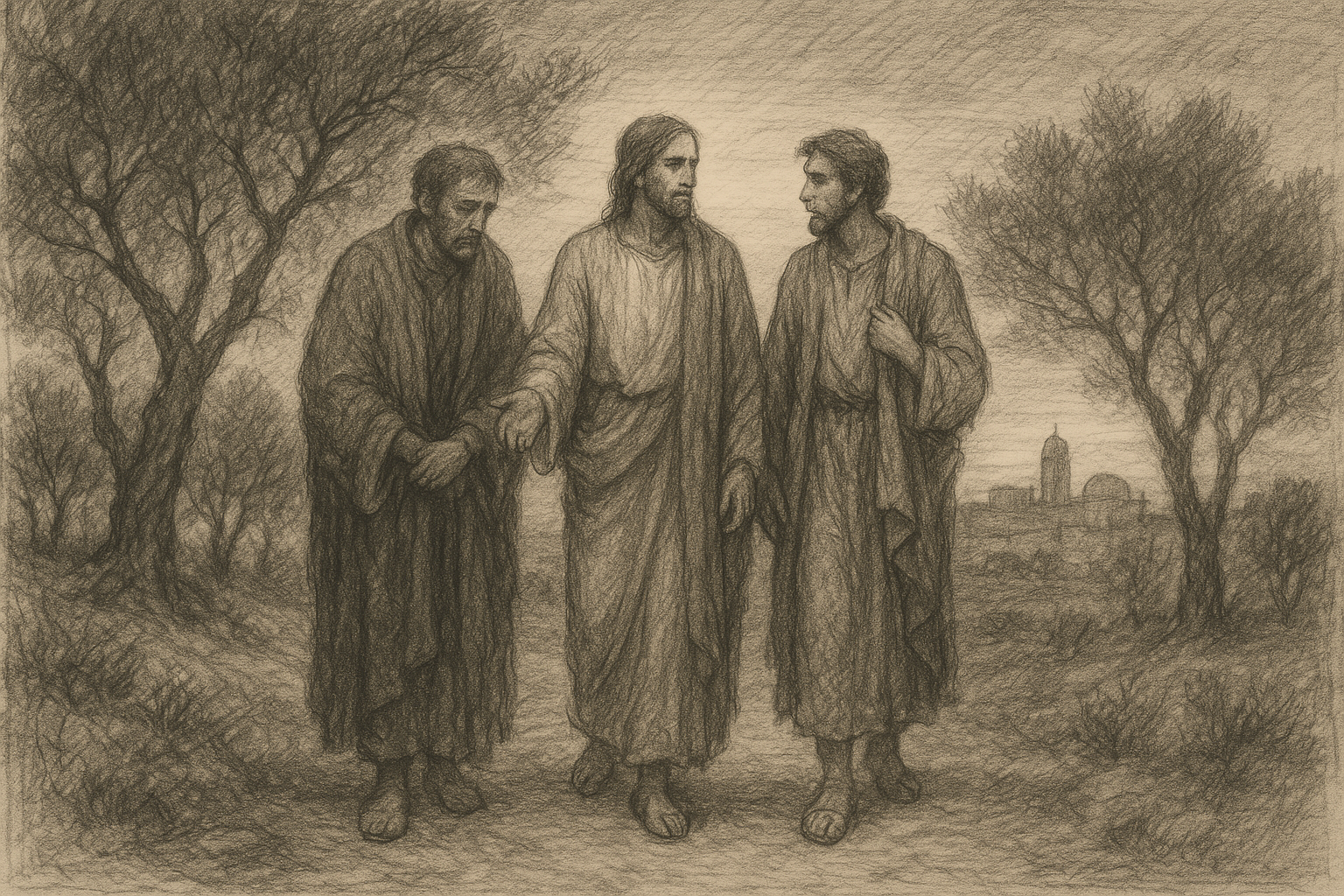
The road to Emmaus in the Gospel is not only a beautiful resurrection story. It is also a carefully shaped portrait of how the risen Christ meets his people. In Luke 24:13 to 35, two disciples leave Jerusalem on the first day of the week, hearts heavy with disappointment. They had hoped for redemption, but the cross had shattered their expectations. What they did not know was that the Lord they mourned was already walking beside them.
This scene has long spoken to Catholics because it brings together several central realities of the faith. Christ is present in our confusion. The Scriptures make sense in the light of his death and resurrection. And the Eucharist reveals him in a way that both fulfills and deepens the journey of faith. Emmaus is a road, but it becomes something more: a school of discipleship, a lesson in hope, and a sign of how Jesus still draws near.
The Gospel setting of Emmaus
Luke tells us that the two disciples were on their way to a village called Emmaus, about seven miles from Jerusalem. They were discussing the recent events surrounding Jesus' crucifixion when the risen Lord came and walked with them, though "their eyes were kept from recognizing him" their eyes were kept from recognizing him. This detail matters. The problem is not only that the disciples are sad. Their sorrow has clouded their sight. They can speak about Jesus, but they cannot yet see Jesus.
One of the deepest features of the passage is the contrast between what the disciples know and what they do not yet understand. They know the facts of the Passion. They have heard the women's testimony about the empty tomb. But they do not know how to interpret these events. Jesus responds not with rebuke first, but with patient instruction.
He begins by asking questions. "What is this conversation that you are holding with each other as you walk?" What is this conversation The Lord who knows all things draws them out. He allows them to speak of disappointment, confusion, and failed hope. Cleopas voices the pain: "We had hoped that he was the one to redeem Israel" We had hoped that he was the one to redeem Israel. That line carries the ache of unmet expectation, and many believers can recognize themselves in it.
Jesus then says, "O foolish men, and slow of heart to believe all that the prophets have spoken" slow of heart to believe. His words are sharp, but not cruel. He is not dismissing them. He is correcting their vision. The resurrection does not erase the cross. It reveals the cross as part of God's saving plan. Christ shows them that suffering was not a failure of God's promise, but part of the path by which the promise would be fulfilled.
How Jesus opens the Scriptures
The center of the Emmaus story is not merely the walk. It is the interpretation of Scripture. Luke says, "Beginning with Moses and all the prophets, he interpreted to them in all the Scriptures the things concerning himself" Beginning with Moses and all the prophets. This is one of the clearest pictures in the New Testament of how Christians are meant to read the Old Testament: in Christ, and from Christ.
The disciples do not immediately recognize Jesus by sight, but they begin to recognize the shape of the biblical story. The Law, the Prophets, and the entire promise of God now come into focus. The Messiah had to suffer and then enter his glory. The pattern is not accident, and it is not defeat. It is salvation.
For Catholics, this resonates with the Church's habit of reading Scripture as one unified story. The Old Testament prepares for Christ, and the New Testament reveals what was hidden in figures and promise. Emmaus is a reminder that the Bible is not just a collection of inspiring texts. It is the living witness to God's plan, a plan that becomes fully luminous in the risen Lord.
There is also a practical lesson here for prayer. Many Christians want quick answers, but Jesus gives a deeper gift: understanding. He does not merely change the disciples' feelings. He changes their minds and hearts by opening the Word of God. When we bring our grief or confusion to prayer, we should not be surprised if the Lord answers first by teaching us how to read our lives in the light of Scripture.
The breaking of the bread and the gift of recognition
The turning point comes at table. The disciples urge Jesus to stay with them, saying, "Stay with us, for it is toward evening and the day is now far spent" Stay with us. They do not yet know how true their invitation is. The one they ask to remain is the one who has been walking with them all along.
Then Luke writes, "When he was at table with them, he took the bread and blessed, and broke it, and gave it to them" he took the bread and blessed, and broke it. These actions echo the Last Supper and the language of the Eucharist. At that moment, "their eyes were opened and they recognized him" their eyes were opened. Recognition comes not only through explanation but through communion.
Catholics have long seen in this passage a profound Eucharistic pattern. Christ is present in the Scriptures, but he is also present in the sacramental breaking of bread. The road to Emmaus becomes a picture of the Mass. First there is the Liturgy of the Word, where Christ speaks and Scripture is opened. Then there is the Liturgy of the Eucharist, where he gives himself as food. The two belong together. The Lord who taught the disciples on the road is the same Lord who feeds his Church at the altar.
The Church has never treated the Eucharist as a mere symbol. Emmaus helps us see why. The disciples do not say, after the meal, that they now feel inspired. They ask, "Did not our hearts burn within us while he talked to us on the road, while he opened to us the Scriptures?" Did not our hearts burn within us Their hearts had already been stirred by the Word, but now their eyes are opened in the breaking of bread. Word and sacrament together disclose the living Christ.
What Emmaus teaches about discipleship
The disciples immediately return to Jerusalem, even though it is evening and they are likely tired from the journey. The text says that they rose "that same hour" and went back to the others that same hour. Encounter with Christ always sends people outward. True consolation is never meant to end in private comfort. It becomes witness.
Emmaus teaches at least four practical lessons for discipleship.
- Stay close to the Lord when hope feels thin. The disciples kept walking, even in confusion. In prayer, that perseverance matters. We do not always begin with clarity. Sometimes faith begins with staying on the road.
- Let Jesus interpret your life. The disciples told their story, and Jesus gave it meaning through Scripture. Catholics are invited to do the same in prayer, asking the Lord to show how his Word sheds light on suffering, delay, and disappointment.
- Make room for the Lord at table. Their invitation, "Stay with us," is one of the great prayers of the Gospel. It is brief, humble, and open. It can become a daily prayer for any Christian who wants the Lord near in ordinary life.
- Return to the Church with what you have received. The disciples do not keep the joy to themselves. They go back to the community. Authentic encounter with Christ draws us into communion, not isolation.
There is also a quieter lesson: Christ often walks with us before we notice him. Many believers have known seasons in which God seemed absent, only to realize later that grace was at work all along. Emmaus does not promise that every sorrow will vanish quickly. It does promise that the risen Jesus is not far from the wounded heart.
Emmaus, the Eucharist, and the life of the Church
The Emmaus account has a lasting place in Catholic imagination because it mirrors the liturgical life of the Church. Christians gather, listen, and are instructed by the Scriptures. Then they approach the altar, where Christ gives himself in sacramental form. The pattern is not forced. It rises naturally from Luke's narrative.
Even the movement from absence to presence has a Eucharistic tone. At first, Jesus is unrecognized. Then he is revealed in the meal. After that, he disappears from sight, but not from communion. The disciples no longer need to cling to visible companionship alone, because they have entered a new mode of presence. That is one reason this Gospel speaks so powerfully to Catholics. In the Eucharist, Christ remains with his Church in a sacramental way that is real, holy, and life-giving.
Emmaus also reminds us that faith is often clarified in retrospect. The disciples understand their burning hearts only after the breaking of the bread. Likewise, many Christians only later see how God was preparing them through a sermon, a passage of Scripture, a moment of quiet, or an encounter at Mass. Grace often leaves traces before it is fully recognized.
For prayer, this means we should value both the road and the table. We need time with the Lord in conversation, and we need reverent encounter in the sacramental life of the Church. We need the Scriptures opened, and we need our hearts fed. The risen Christ gives both.
Praying with Emmaus today
If you want to pray with this Gospel passage, begin simply. Read the scene slowly. Notice the emotions of the disciples. Bring your own disappointments to the text. Ask where your hope has become tired, or where you may have been expecting Christ in one form while he is approaching in another.
Then pray the verse "Stay with us." Let it become your own. Ask Jesus to remain with you in your work, your family, your fears, and your moments of decision. Ask him to open the Scriptures to you, especially the passages that have become familiar but not yet luminous.
Finally, approach the Eucharist with Emmaus in mind. The same Lord who walked beside the disciples still comes to his people. He still instructs. He still gives himself. And he still sends his followers back into the world with a renewed heart and a clearer sight.
The road to Emmaus in the Gospel remains a living witness that Christ meets the discouraged, teaches the ignorant, and feeds the hungry. He does not abandon the journey. He joins it, blesses it, and turns it toward resurrection.
Keep Reading on Lets Read The Bible
Frequently Asked Questions
Where is the road to Emmaus found in the Bible?
The Emmaus story is found in Luke 24:13 to 35. It takes place on the first day of the week after the Resurrection, when two disciples are walking from Jerusalem to Emmaus and Jesus joins them on the road.
How is Emmaus connected to the Eucharist?
Catholics see a strong Eucharistic pattern in Luke 24. Jesus opens the Scriptures on the road, then is recognized in the breaking of the bread at table. This mirrors the structure of the Mass, with the Liturgy of the Word and the Liturgy of the Eucharist.
Why did the disciples not recognize Jesus right away?
Luke says that their eyes were kept from recognizing him. The story suggests both a divine mystery and the effect of grief and confusion. Their recognition comes when Jesus opens the Scriptures and breaks the bread, showing that faith often grows through both teaching and sacramental encounter.