Church History
St. Gregory the Great and the Making of a Shepherd for Hard Times
A look at the pontificate that helped steady the Church in a time of upheaval, prayer, and reform.
Site Admin | December 23, 2025 | 72 views
Few popes stand at the crossroads of so much change as St. Gregory the Great. When he became Bishop of Rome in 590, the ancient world was still visible, but it was already breaking apart. Cities were weakened, civil life was unstable, and the Roman people looked to the Church for guidance, relief, and moral steadiness. In that setting, Gregory did not govern as a theorist. He governed as a pastor who had known the pull of public service, the discipline of monastic life, and the demands of a Church trying to serve a wounded world.
The St. Gregory the Great history is not only the story of one pope. It is also the story of how the Church learned to lead through fragility. Gregory's long influence reached liturgy, missionary work, charitable care, and the practical shape of papal leadership. He became one of the great fathers of the medieval papacy, but he also remained deeply Roman in the older sense: sober, organized, and attentive to the real needs of souls.
A Church in an unsettled age
Gregory was born into a distinguished Roman family around 540, at a time when Italy was still bearing the wounds of war. The old imperial structures had not vanished all at once, but they no longer carried the same force. Political authority was divided, and Roman life was marked by insecurity. Floods, famine, plague, and conflict made ordinary stability difficult. In such an age, the Church was often the one institution people could trust to remain present.
Before becoming pope, Gregory had already experienced public administration. He served as prefect of Rome, a role that gave him practical knowledge of government and human weakness. Yet he eventually turned away from that career and embraced monastic life. That choice mattered. It shaped the spiritual center from which he would later lead. Gregory was never a naive idealist. He understood administration because he had done it. He understood prayer because he had chosen it.
From the monastic perspective, he wrote and thought as someone who knew that action without interior life becomes empty, while contemplation without charity can become detached. That balance would mark his pontificate.
How Gregory became pope
Gregory was not eager for prominence. Even after becoming a deacon and serving the Church in important ways, he remained drawn to the contemplative life. Tradition holds that he founded or supported a monastery connected to his home in Rome. His sense of vocation was shaped by humility rather than ambition.
When he was elected pope in 590, Rome was in distress. The city was suffering from plague, and the broader region faced repeated instability. Gregory's election was not a triumphal moment. It was a burden laid upon a man known for prudence and spiritual seriousness. He accepted it, not as a personal promotion, but as a duty before God.
This is one reason his witness still speaks clearly. Gregory did not imagine that holiness meant withdrawal from responsibility. He believed the pastor must carry the flock through real danger, even when he would rather remain in prayer. The office required him to become a servant to a suffering people.
Major challenges during his pontificate
Gregory's papacy unfolded amid several overlapping crises. The first was political fragility. Italy faced pressure from the Lombards, and Roman civic life lacked the strength it once had. Gregory had to negotiate, intervene, and care for the city in ways that blended diplomacy with moral concern.
Second was the burden of material suffering. Famine and poverty were not abstract concerns. They shaped daily life. Gregory became known for the Church's practical charity. He organized relief and insisted that the goods of the Church should serve the needs of the poor. His famous concern for almsgiving was not a decorative virtue. It was central to his understanding of the papal office.
Third was the spiritual and liturgical task of guarding the unity of the Church. Gregory had to preserve doctrine, support discipline, and foster reverence in worship. He lived in a time when local customs varied widely and when the Church needed both continuity and wise adaptation. His leadership helped give the Roman liturgical tradition a clearer and more durable shape.
He also faced the missionary horizon. The Church in western Europe was still being consolidated, and many peoples had not yet been evangelized. Gregory understood that the faith could not remain enclosed within old Roman structures. It had to be carried outward.
The liturgical legacy attached to his name
St. Gregory the Great is closely associated with the liturgy, especially the Roman chant tradition that later came to be called Gregorian chant. Care must be taken here, because not every musical development attributed to him can be directly proven in simple historical terms. Still, the Church has long recognized Gregory as a key figure in the ordering and promotion of sacred worship.
His importance lies not only in music itself but in the larger principle that worship should be dignified, ordered, and shaped toward God. Gregory wanted the Church's prayer to be sober, beautiful, and worthy of the mysteries being celebrated. In that sense, his influence is not merely antiquarian. It continues wherever Catholics seek a liturgy that is prayerful, disciplined, and free from self-display.
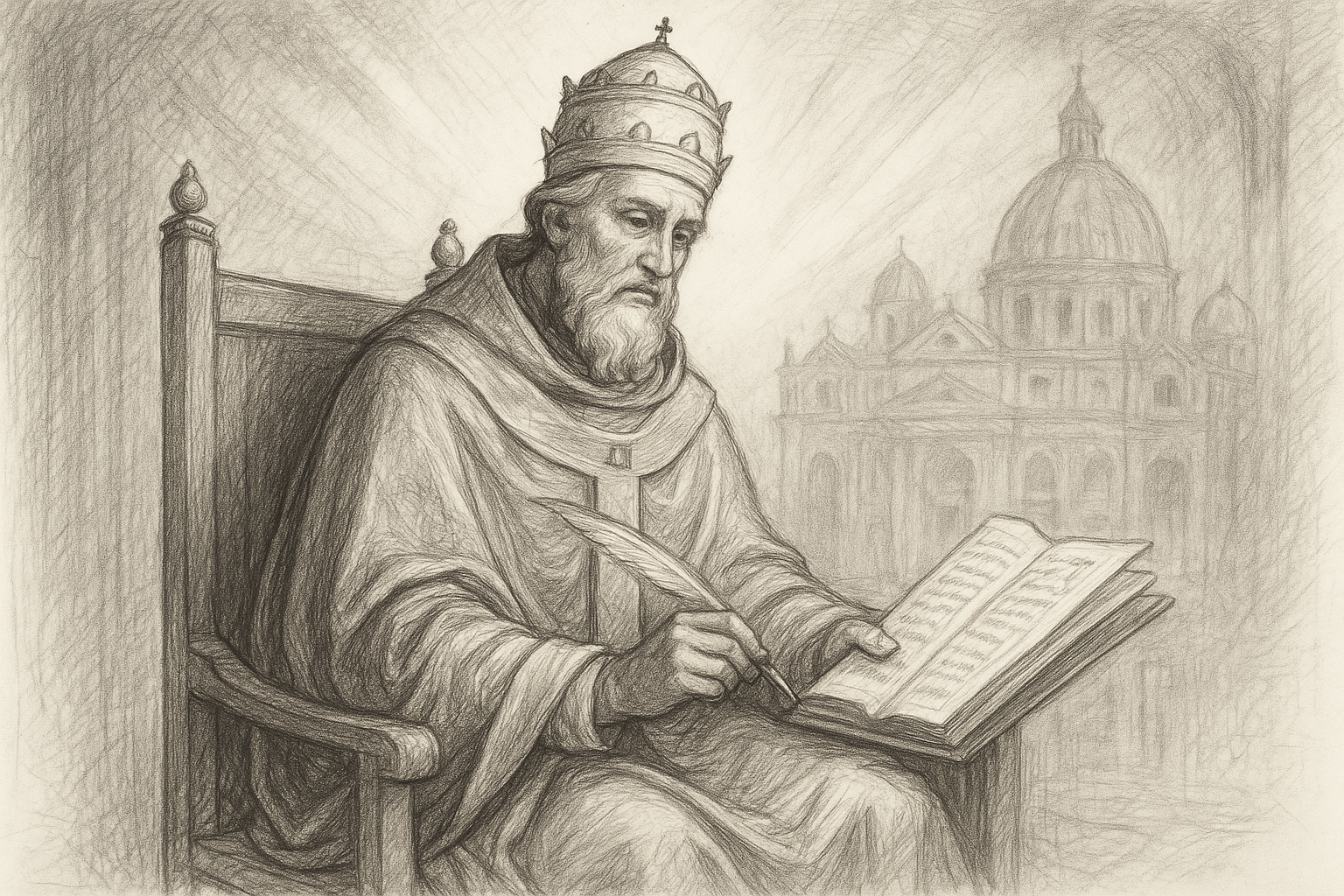
He also wrote a great deal on the spiritual life and on pastoral responsibility. His Pastoral Rule became one of the most important manuals for bishops and clergy in the Middle Ages. There he described the qualities needed in a shepherd of souls, including humility, discernment, and the ability to speak differently to different people according to their needs. The book is practical, but it is also deeply theological. The pastor serves by imitating Christ the Good Shepherd.
Gregory's liturgical concern was never isolated from charity. For him, worship and mercy belonged together, because both must be ordered to the glory of God and the salvation of souls.
Gregory as a missionary pope
One of the most famous events attached to Gregory's name is the mission to England. Gregory sent Augustine, later known as St. Augustine of Canterbury, with companions to preach the Gospel to the Anglo-Saxons. This mission became one of the defining moments in the Christianization of England.
Gregory's approach to mission was thoughtful and adaptable. He did not assume that evangelization meant erasing everything local. Instead, he encouraged a patient method that sought to purify and elevate what could be received, while remaining faithful to the faith itself. That pastoral realism is one of the reasons he is remembered with affection not only in Rome but also in lands evangelized through Roman initiative.
His missionary concern extended beyond one island. Gregory had a broad vision of the Church's duty to proclaim Christ to peoples still outside the Christian fold. He saw mission as part of the pope's responsibility, not as an optional project. The Church that prays is also the Church that sends.
What Gregory teaches about leadership
Gregory's greatest strength may have been his refusal to separate spiritual authority from practical responsibility. He was a theologian, but he was also an administrator. He was a monk, but also a public leader. He was a bishop, but he never forgot the poor. These combinations made him effective in a time that needed steady hands.
Modern Catholics can learn several lessons from his witness:
- Lead from prayer. Gregory's strength came from interior discipline, not personality alone.
- Serve concrete needs. Doctrine and liturgy matter, but so do food, peace, and justice for the vulnerable.
- Value orderly worship. Sacred liturgy forms the Church and teaches reverence.
- Accept responsibility without vanity. Gregory's humility made his authority credible.
- Think missionally. The faith is meant to be handed on, not kept private.
His example also warns against a shallow view of reform. Gregory did reform, but he did not imagine reform as novelty for its own sake. He worked within the Church's inheritance and sought to strengthen what was true and fruitful. That instinct remains valuable. Catholics today often face the temptation to treat renewal as either nostalgia or disruption. Gregory offers a third way: patient fidelity shaped by charity and truth.
Why his witness still feels close
Gregory lived in a world where many institutions were weakening. That makes him surprisingly contemporary. Catholics today also know the feeling of instability, though in different forms. Cultural confusion, spiritual fatigue, and the pressure of practical needs can make the Church seem stretched thin. Gregory does not offer a simple solution, but he does offer a pattern of faithful response.
He teaches that the Church is strongest when her shepherds are men of prayer who are willing to bear burdens. He shows that the care of souls includes liturgy, teaching, discipline, and mercy. He reminds us that the pope is not simply a symbol of unity but a servant of communion. And he shows that holiness is not less real in the midst of administration, but more necessary there.
The memory of St. Gregory the Great is enduring because it joins doctrine to action, worship to service, and authority to humility. In a time when the world around him was shifting, he did not try to control history by force. He handed himself over to the work God had placed before him, and in doing so he helped shape the Church for centuries to come.
For Catholics who look to the saints for clarity, Gregory remains a sturdy guide. He is the pope who knew that the shepherd must stay with the flock, even when the road is rough, and that the Church's beauty is most convincing when it is joined to mercy.
Keep Reading on Lets Read The Bible
Frequently Asked Questions
Why is St. Gregory the Great so important in Church history?
He helped guide the Church through political collapse, strengthened papal leadership, promoted charity, supported mission, and influenced the liturgical tradition of Rome.
Did St. Gregory the Great create Gregorian chant?
The chant tradition associated with his name developed over time, and not every detail can be traced directly to him, but he is rightly linked with the ordering and reverence of Roman liturgy.
What is one major work by St. Gregory the Great that Catholics should know?
His Pastoral Rule is one of his most important works. It explains how bishops and priests should care for souls with humility, discernment, and fidelity to Christ.