Church History
St. Leo the Great and the Strength of a Clear Voice in a Troubled Age
A look at the pope who defended the faith, steadied a shaken Church, and left a lasting mark on Catholic memory
Site Admin | December 21, 2025 | 76 views
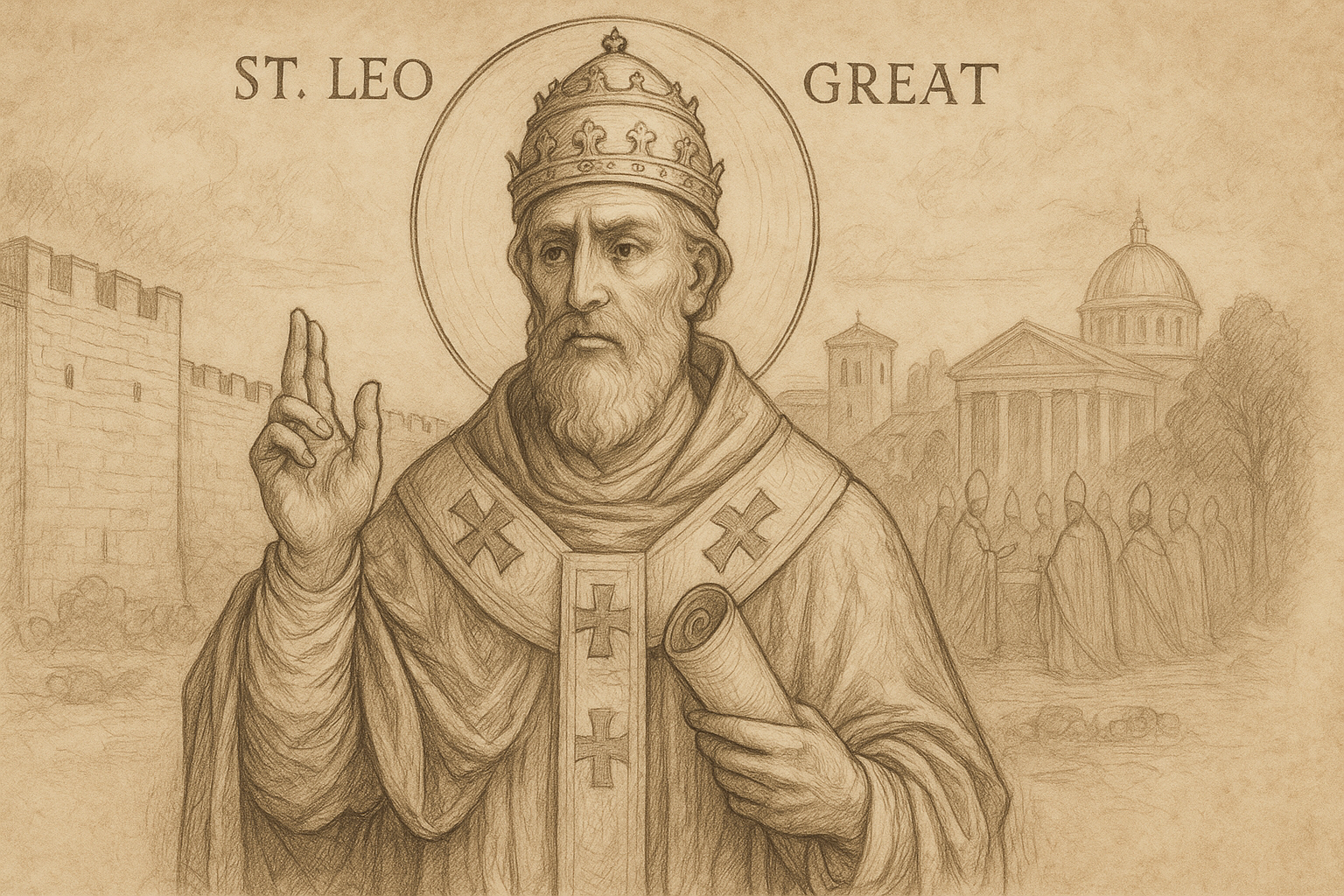
St. Leo the Great history belongs to one of the most unsettled periods in the Church's early centuries. Leo became bishop of Rome in 440, when the Western Roman Empire was weakening, public life was unstable, and the Church was learning how to speak with firmness in a world of political decline and theological dispute. He is remembered not only as a strong pope, but also as a Doctor of the Church, which means his teaching carried lasting weight for Catholic faith and life.
What makes Leo so compelling is that he did not lead in a calm age. He led when Rome itself was under pressure, when Christian doctrine needed careful defense, and when the practical unity of the Church required a shepherd who could think clearly and act decisively. His witness still speaks to Catholics who want to understand how truth and charity belong together in times of uncertainty.
The world Leo inherited
Leo's pontificate unfolded against the decline of imperial power in the West. The city of Rome was still symbolically important, but the empire no longer had the strength it once claimed. In that setting, bishops increasingly carried civic as well as spiritual responsibilities. The bishop of Rome was no longer merely one voice among many. He was becoming a central figure in preserving order, mediating conflict, and teaching with authority.
The Church also faced internal questions. Christological controversy was especially serious. Christians needed language precise enough to defend both the divinity and the true humanity of Jesus Christ. Confusion about the person of Christ was not an abstract problem. It affected the heart of salvation, because if Christ is not truly God and truly man, then the Incarnation is emptied of its saving power.
Leo entered this world with uncommon clarity of mind and steadiness of purpose. He understood that the Church cannot surrender truth when the pressure of the age makes compromise seem attractive. His letters, sermons, and interventions show a pope deeply concerned that the faith handed on by the apostles remain intact and intelligible.
A pope formed for crisis
Little from Leo's early life is certain in detail, but he had already gained considerable reputation before his election. He was known for practical wisdom, theological seriousness, and administrative skill. Those gifts mattered because the chair of Peter in that era required more than ceremonial dignity. It required judgment, patience, and a willingness to bear burdens for the sake of unity.
One of Leo's great strengths was his ability to connect doctrine with pastoral care. He did not treat theology as a private intellectual pursuit. For him, right teaching protected Christian prayer, worship, and the moral life. If people know who Christ is, they can know who they are called to become in Him. That conviction runs through much of his writing.
Leo also had a deep sense of Roman responsibility. He saw the See of Peter as serving the whole Church. His letters to bishops across the Christian world show a pope who expected discipline, but also a pope who wanted local churches to flourish in fidelity. He was not interested in novelty. He was interested in continuity with apostolic faith.
Defending the truth about Christ
The issue most closely linked to Leo's name is the controversy over the person of Christ. In the fifth century, debates about how divine and human nature relate in Jesus had become intense. The Church needed language that preserved both natures without confusion or division.
Leo's most famous doctrinal text is the Tome of Leo, a letter addressed to Flavian, the patriarch of Constantinople. In it, Leo explained that Jesus Christ is one person in two natures, truly divine and truly human. This was not a dry formula. It protected the Catholic belief that the Son of God truly entered our condition, suffered in the flesh, and redeemed us from within human history.
The Tome became central at the Council of Chalcedon in 451. According to the well-known account, the bishops received Leo's teaching with great reverence, recognizing its agreement with the apostolic faith. The council's Christological definition, which affirmed Christ as one person in two natures without confusion, change, division, or separation, stands as one of the great doctrinal landmarks of Christian history. Leo's role in that achievement is one reason he is numbered among the Doctors of the Church.
For Catholics, this matters because doctrine is not decorative. It is the form of truth by which the Church remains herself. Leo helped the Church say clearly what it means that the Word became flesh. In doing so, he defended the possibility of salvation itself.
The bishop who stood before Attila
Leo's name is also attached to one of the most memorable episodes in late antique history. In 452, Attila the Hun advanced into Italy. Accounts tell us that Leo went out to meet him near the River Mincio. The details of the encounter are not fully known, and historians do not reduce the event to a simple explanation. Military, political, and practical factors all likely played a role in Attila's withdrawal.
Still, the image has endured because it captures something true about Leo's office and character. He represented a Church that did not hide in fear when danger approached. He stepped forward as a peacemaker, a moral authority, and a public witness. Even in a collapsing world, the bishop of Rome could stand in the path of violence and plead for mercy.
This episode should not be romanticized into legend alone. Yet it does reveal Leo's readiness to act for the common good. A pope is not a mere administrator. He is called to shepherd souls, but he also speaks for Christian civilization when innocent life and civic order are at stake. Leo understood that responsibility in a concrete way.
Rome under siege and the care of souls
Three years later, in 455, Rome suffered another devastating crisis when the Vandals sacked the city. Leo again intervened, this time in a season of humiliation and loss. He worked to mitigate destruction and to protect the vulnerable where possible. The age was marked by political weakness, but Leo did not allow weakness to become despair.
These events help explain why his legacy was not only theological but also pastoral. He was a pope who knew that people need both sound doctrine and a steady hand in crisis. Churches can be shaken by doctrinal dispute, but they can also be shaken by war, fear, and social disorder. Leo responded to both kinds of suffering with the same basic conviction: Christ is Lord, and the Church must remain faithful.
His sermons show that he preached this conviction with grace and force. He wrote as a shepherd who expected his people to rise to the dignity of the faith they had received. He called Christians to live what they believed, especially in the liturgical seasons of the Church. His preaching links the mysteries of Christ to ordinary Christian conversion.
A Doctor of the Church with a pastoral mind
Leo was later named a Doctor of the Church because his teaching remained especially important to the whole Church. That title does not mean he was a speculative theologian in the modern academic sense. It means his doctrine was sound, fruitful, and enduring.
His writings show a mind that held several truths together at once. He defended orthodoxy without coldness. He upheld papal responsibility without treating it as a worldly status symbol. He taught with precision, but his goal was always the salvation of souls. That balance is part of what makes him such an important figure in St. Leo the Great history.
Leo also offers a rich example of Christian leadership. He did not confuse strength with harshness. He did not confuse mercy with vagueness. He knew that charity sometimes requires a firm sentence, a clear warning, or a patient explanation. In an age of doctrinal confusion, he served the Church by making the truth easier to recognize.
What modern Catholics can learn from Leo
Leo's witness remains striking because modern Catholics still live amid confusion, pressure, and rapid change. His life suggests several enduring lessons.
First, truth must be spoken clearly. Leo did not assume that sincerity alone was enough. He knew that Christ must be named rightly if the faith is to remain whole. Catholics today can learn to love clarity without becoming combative.
Second, doctrine serves communion. Leo's teaching on Christ was not an exercise in argument for its own sake. It protected worship, preaching, and the unity of the Church. Sound doctrine is pastoral because it keeps the Church anchored in what is real.
Third, courage is a form of charity. Whether facing theological controversy or political danger, Leo acted for the good of others. Christian courage is not self-display. It is the willingness to stand where others need someone to stand.
Fourth, the office of Peter is meant for service. Leo understood the Roman primacy as a call to strengthen the whole Church. His example helps Catholics see papal authority not as a mere institution, but as a ministry ordered to unity in the apostolic faith.
Fifth, a saint can be both firm and prayerful. Leo's sermons and letters show a man who did not separate worship from governance, or theology from holiness. He belonged to a Church that prayed before it argued, and taught because it believed.
Leo's place in Catholic memory
St. Leo the Great remains important because he helped the Church hold fast in a time when it would have been easy to drift. He defended the faith of the Incarnation, strengthened the authority of the Roman See, and gave the Church an image of episcopal courage that endures to this day. His pontificate reminds Catholics that history is not only shaped by emperors and armies. It is also shaped by shepherds who know when to teach, when to intervene, and when to stand in the breach.
For readers seeking to pray with the Church's memory, Leo offers more than a name in a calendar. He offers a way of seeing Christian leadership as a responsibility before God. He teaches that the Church is strongest when her shepherds are clear about Christ, attentive to souls, and willing to act for peace. In every age, that is no small gift.
To remember Leo is to remember that the faith is not preserved by sentiment alone. It is preserved by witness, by doctrine, by worship, and by courage rooted in Christ, who is one Lord in whom the fullness of divinity and true humanity are forever united.
Keep Reading on Lets Read The Bible
Frequently Asked Questions
Why is St. Leo the Great called a Doctor of the Church?
He is called a Doctor of the Church because his teaching was especially important, sound, and lasting. His Christological writings, especially the Tome of Leo, helped the Church express the faith clearly and defend the true divinity and humanity of Jesus Christ.
What is St. Leo the Great best known for in Church history?
He is best known for defending orthodox teaching about Christ, influencing the Council of Chalcedon, and for his role in meeting Attila the Hun and later responding to the sack of Rome. He is also remembered for strong papal leadership during a period of decline and crisis.
What can Catholics learn from St. Leo the Great today?
Catholics can learn to value doctrinal clarity, courage in hard times, and a sense of responsibility for the common good. Leo shows that true pastoral leadership joins truth, charity, and steadiness under pressure.