Jesus and the Gospels
A Vineyard at Dusk and the Gift of an Equal Share
Jesus turns our instinct for comparison upside down and reveals the generosity of God at the heart of the Kingdom.
Site Admin | March 9, 2026 | 70 views
The parable that unsettles our sense of fairness
Few of Jesus' parables seem to trouble our instincts as quickly as the workers in the vineyard. In the story, a landowner hires laborers at different hours of the day, yet at evening he gives each one the same wage. Those who worked longer complain, and their complaint sounds instantly familiar. Human beings notice differences. We count hours, compare effort, and expect rewards to match visible labor.
That is precisely why the parable is so memorable. Jesus is not offering a lesson in wage policy or suggesting that justice ignores work well done. He is speaking about something deeper: the surprising generosity of God, the logic of the Kingdom of Heaven, and the temptation to measure grace by comparison.
The story appears in [[VERSE|matthew|20|1-16|Matthew 20:1-16]], where Jesus says the Kingdom of Heaven is like a landowner who goes out early in the morning to hire workers for his vineyard. He returns at the third hour, sixth hour, ninth hour, and even at the eleventh hour. When evening comes, he pays all of them one denarius. To modern readers, the equal payment can seem unfair. To Jesus' first hearers, it would have sounded just as sharp. The parable is meant to provoke the heart before it settles the mind.
The story in its biblical setting
Vineyards mattered in the world of Israel. They were signs of fruitfulness, labor, and covenant blessing. The prophets often used vineyard imagery to speak about God's care for his people and the responsibilities that come with being planted and tended by the Lord. Jesus' listeners would have recognized that a vineyard was not just a field of vines. It was a place where the work of cultivation, patience, and harvest carried spiritual weight.
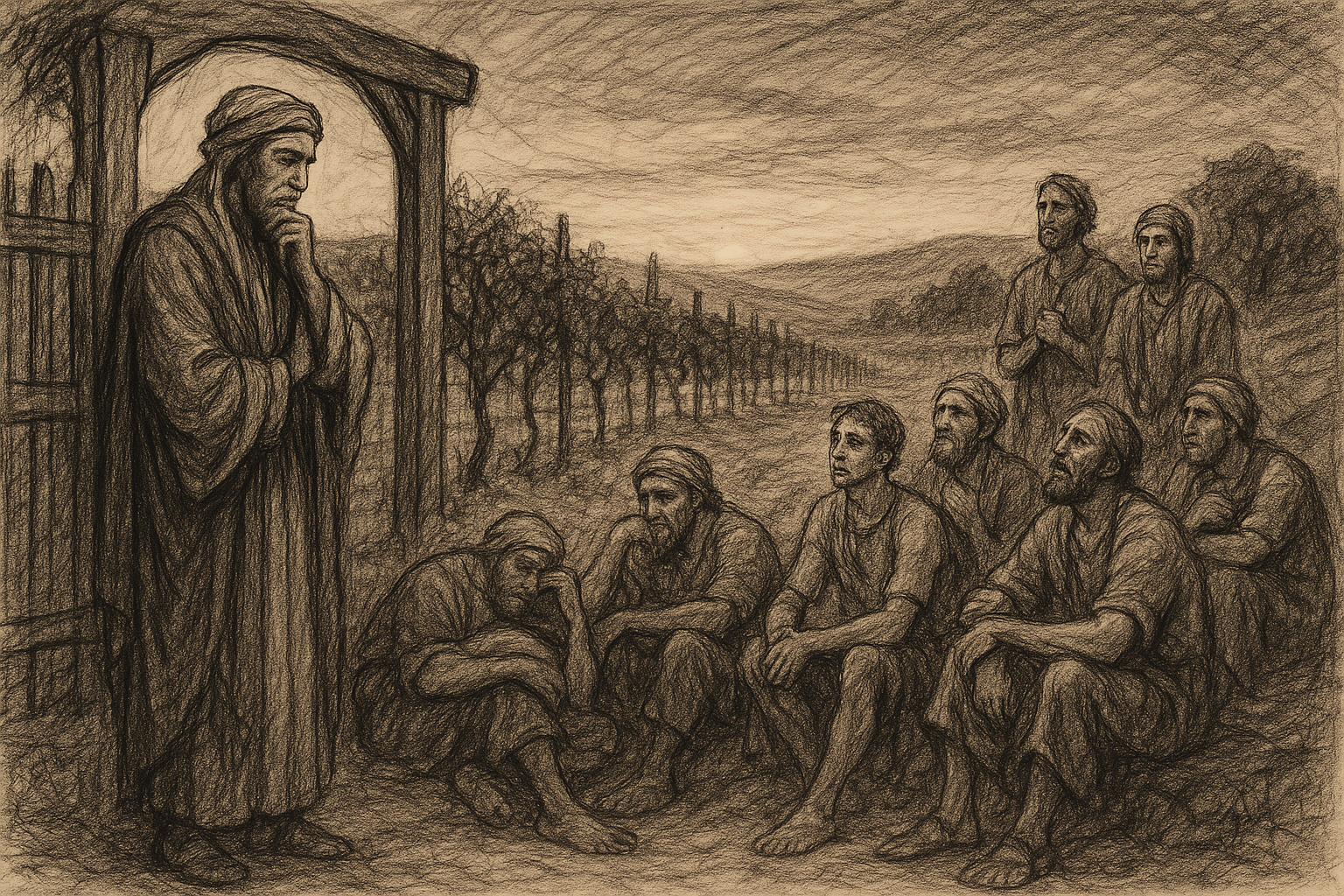
The landowner in the parable goes out again and again to find laborers. This detail is important. He is not indifferent. He sees idle men standing in the marketplace and asks why they are there all day. They answer, "Because no one has hired us." He sends them into his vineyard. The repeated invitations suggest a God who seeks, calls, and draws people into his work at various points in life.
At the end of the day, the landowner tells his steward to pay the laborers beginning with the last and ending with the first. This reversal is not accidental. Jesus often overturns human rankings. In the Kingdom, the order we assume is natural is frequently changed. The first become last, the last become first, and the fatherly generosity of God is shown to be larger than our calculations.
Grace is not earned like a prize
The heart of the parable is grace. Catholics know that salvation is entirely God's gift, yet we also know that grace calls for cooperation. The parable holds these truths together without flattening either one. The laborers really do work. Their labor is real. But the wage they receive is not a reward that can be reduced to a simple formula of human merit.
Saint Paul teaches that salvation is a gift, not a human achievement. He also teaches that believers are created in Christ Jesus for good works [[VERSE|ephesians|2|8-10|Ephesians 2:8-10]]. The workers in the vineyard remind us that our efforts matter, but they matter within a covenant of mercy. God does not owe us eternal life as though he were settling a debt. He gives life because he is good.
For Catholics, this matters in a very practical way. It is easy to begin thinking of the spiritual life as a ledger: prayers said, fasts observed, duties completed, sins avoided. All of these disciplines are valuable, but they become dangerous when they turn into a way of ranking ourselves before God. The parable strips away pride by showing that the Lord is not impressed by our comparisons. He asks not whether we have outperformed our neighbor, but whether we have trusted him.
"Are you envious because I am generous?" Matthew 20:15
That question reaches deeper than irritation about wages. It exposes the envious heart. Envy is not only sadness at another person's good. It can also be resentment that God's gifts are not distributed according to our preferred order. The landowner's response reminds us that divine generosity does not threaten justice. It reveals the freedom of God to be merciful.
The laborers who arrived late are not second class
One of the most consoling aspects of the parable is that those hired late are not shamed. They are not given less food, less dignity, or a token payment. They receive a full denarius, the agreed daily wage. The landowner does not say, in effect, that their work is worthless. He honors them by giving them what is fitting for a day's survival and by refusing to let the stopwatch become the judge of their worth.
This has obvious spiritual resonance. Many people come to the faith late, after years of distance, confusion, or even open resistance. Some return to confession after a long absence. Others encounter Christ in adulthood after living for a long time outside the life of the Church. Still others struggle with long seasons of weakness and only gradually learn trust. The parable announces that no one is too late for God's mercy.
That does not make conversion casual. The workers still enter the vineyard when called. The point is not that timing does not matter at all. The point is that when the Lord calls, his generosity outruns our anxiety. The eleventh hour is not beyond his reach.
Catholic tradition has long cherished this truth. The sacraments are not trophies for the spiritually advanced. They are acts of divine mercy given for sinners who need grace. In Baptism, Confirmation, the Eucharist, Penance, Anointing of the Sick, Holy Orders, and Matrimony, God meets his people not because they have earned divine favor, but because he freely chooses to bless, heal, and sanctify.
The danger of comparing our path with someone else's
Much of the bitterness in the parable comes from comparison. The first laborers do not object to the amount they were promised. They object because others receive the same amount. Their complaint begins when they look sideways.
Comparison is one of the quiet spiritual diseases of ordinary life. We compare the visible fruit of our work with the visible fruit of another person's work. We compare our trials, our parish roles, our vocations, our families, and even our apparent holiness. Yet the spiritual life is never lived on a level playing field of appearances. God knows the hidden burdens, hidden sins, and hidden sufferings that no one else sees.
Jesus' parable teaches that the Kingdom cannot be managed by comparison. A faithful mother, a patient priest, a convert who came late to the faith, a consecrated religious in hidden prayer, a laborer whose life has been marked by hardship, and a child who dies in innocence are all under the same merciful gaze of God. Human categories struggle to hold this together. The parable invites us to let God be God.
This does not erase distinctions of vocation or responsibility. A child does not carry the same obligations as a bishop. A married layperson does not live the same life as a cloistered nun. But the source of every vocation is grace, and the final end of every vocation is communion with God. That shared end matters more than our competition for spiritual status.
What the parable says about justice and generosity
Catholics should be careful not to misread the parable as if justice were unimportant. Scripture does not praise unfairness. Rather, Jesus shows that strict human accounting is not the highest form of justice. The landowner is just because he gives each worker what he promised. He is generous because he gives more than the earliest laborers expected the latecomers to receive.
In that sense, the story reveals two truths at once. God is faithful to his word, and God is free to be lavish. Justice and mercy are not enemies in the divine life. Mercy does not cancel justice; it fulfills justice by bringing the needy into communion with the giver.
The early workers want distinction. They want to be recognized as more deserving because they bore the heat of the day. But the landowner's question exposes the assumption behind their grievance. If they received what was promised, then the deeper issue is not injustice. It is the discomfort of seeing generosity extended to others. The spiritual lesson is sobering: the human heart can resent grace when it appears to treat others too well.
That is why the parable has a strong moral edge. It calls us to examine whether we have become attached to our own merits, our own sacrifices, or our own identity as the diligent ones. The Kingdom of Heaven belongs to those who receive it as gift.
Living the parable in Catholic life
How should Catholics live this message today? First, by thanking God for his mercy rather than treating it as an abstraction. Gratitude is the proper response to a God who calls laborers into his vineyard at every hour of the day. If we entered early, we should not boast. If we entered late, we should not despair.
Second, by making room for joy when others are blessed. The saints are never jealous of God's generosity. Heaven is not a competition for limited seats. When someone returns to the sacraments, grows in virtue, or receives unexpected help, we should learn to rejoice. The landowner's goodness is not diminished because another worker receives a full wage.
Third, by remaining faithful to the work given to us. The parable does not honor idleness. Those who are called are sent into the vineyard. Catholics are not saved by passivity. We cooperate with grace through prayer, repentance, charity, worship, and perseverance. We labor because the Lord has invited us into his work, not because our labor earns his love.
Finally, by entrusting time itself to God. Some people experience a long, steady life of faith. Others stumble, pause, return, and begin again. The Lord's mercy does not measure the value of a life only by its visible duration in service. He sees the whole story. He can make fruitful what seems late, damaged, or incomplete.
Practical ways to pray with the parable
- Thank God each day for gifts you did not earn, especially the sacraments and the faith.
- Ask for freedom from envy when others seem to receive what you hoped for.
- Offer your labor to Christ as service in his vineyard, not as a claim on his favor.
- Pray for those returning to the Church after many years away, that they may know the Father's welcome.
The workers in the vineyard do not flatter our desire to be measured against others. Instead, they invite us to stand before a generous Lord who gives more than we deserve and less than our pride demands. That is the strangeness of grace. It can unsettle us, humble us, and, if we let it, free us to love God for who he is.
Keep Reading on Lets Read The Bible
Frequently Asked Questions
What is the Workers in the Vineyard Catholic meaning?
The Workers in the Vineyard Catholic meaning is that God's grace is a free gift, not something earned by comparing ourselves with others. The parable teaches both God's justice and his generosity, especially toward those who come to him late.
Does the parable mean effort does not matter?
No. The workers are truly sent into the vineyard, and their labor is real. The parable does not dismiss effort; it shows that even our faithful labor depends on God's prior call and mercy.
How can Catholics apply this parable in daily life?
Catholics can apply it by practicing gratitude, resisting envy, honoring different vocations, and trusting God's timing. It also encourages prayer for those returning to the sacraments or coming to faith later in life.