Jesus and the Gospels
When Jesus Comes to the Boat: Faith on the Water in the Gospels
The walking on water episode reveals Christ's authority, Peter's wavering faith, and the quiet grace that meets disciples in fear.
Site Admin | February 8, 2026 | 58 views
The night the disciples saw the Lord on the sea
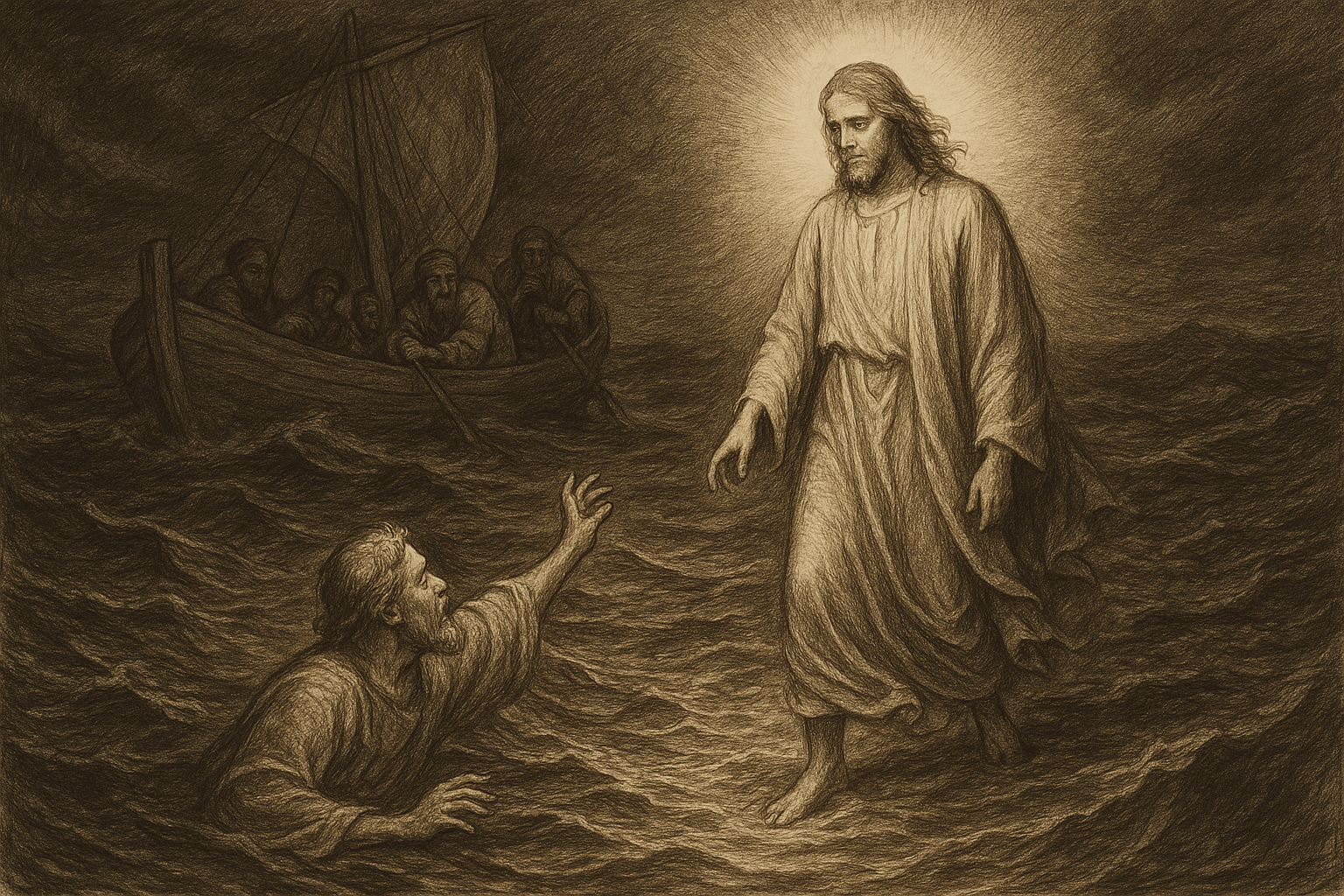
The scene is one of the most striking in the Gospels. After the feeding of the multitude, Jesus sends the disciples ahead by boat while he goes up the mountain to pray. By nightfall the boat is far from land, the wind is against them, and the waves are heavy. Then, in the fourth watch of the night, Jesus comes toward them walking on the water. The disciples are terrified, thinking they have seen a ghost, but Jesus speaks a word that changes everything: "Take courage, it is I; do not be afraid" Take courage, it is I; do not be afraid.
This moment appears in the Gospels as a true event, not a parable or legend. It is part of the Lord's public ministry, and it reveals who he is. The sea, in biblical imagery, often represents chaos, danger, and powers beyond human control. When Jesus walks upon it, he is not struggling against the waters. He is Lord over them.
For Catholics, the miracle is not only about amazement. It is about revelation. Christ does what only God can do. He enters the storm, meets his disciples in fear, and shows that divine presence is not absent when the night is dark. In fact, this is often the very hour when the Lord draws near most clearly.
The biblical setting gives the miracle its depth
Matthew's account is especially rich because it places the walking on water within the rhythm of Jesus' ministry. First comes the feeding of the five thousand, a sign of abundant divine care. Then Jesus dismisses the crowd and goes apart to pray. The disciples, meanwhile, are sent into rough water. The movement matters. The Lord feeds, prays, and then meets his own in distress.
Mark tells the same basic event with its own emphasis. There Jesus sees the disciples straining at the oars, for the wind is against them, and he comes to them walking on the sea, intending to pass by them He came toward them walking on the sea. That phrase, "intending to pass by them," echoes Old Testament language of divine revelation. The God of Israel is the one who reveals his glory while remaining sovereign and free. The Gospel is quietly saying that Jesus shares in that same divine identity.
John's account adds another layer. When the disciples are alarmed, Jesus says, "It is I; do not be afraid" It is I; do not be afraid. In the Greek, the phrase can also carry the sense of "I am," which resonates with God's self-revelation in Scripture. John often writes in a way that invites readers to see beyond the surface of the event. Jesus is not merely a wonder-worker. He is the one in whom God's saving presence comes near.
So the miracle is historical, but it is also theological. It tells the truth about Christ. He is not trapped by the elements, and he is not distant from his disciples' struggle. He rules creation, and he comes close to those who are afraid.
Peter's request shows both boldness and weakness
Matthew alone records Peter stepping out of the boat. That detail has always drawn readers because Peter is so recognizably human. He does not merely watch. He asks, "Lord, if it is you, command me to come to you on the water" Lord, command me to come to you on the water. Jesus answers with one word: "Come."
Peter then begins to walk toward Jesus, and this is an image of discipleship in miniature. Faith is not the absence of risk. It is the act of responding to Christ's word. Peter can walk because he is looking toward the Lord who called him.
But when he notices the wind, fear returns. He begins to sink and cries out, "Lord, save me!" Lord, save me. That prayer is short, urgent, and perfect. It is the prayer of a disciple who knows exactly whom to call upon when his own strength fails.
Jesus immediately stretches out his hand and catches him. Only after saving him does he ask, "O you of little faith, why did you doubt?" O you of little faith, why did you doubt. The rebuke is real, but so is the mercy. Christ does not leave Peter under the waves while he reflects on his failure. He rescues him first.
This is an important Catholic lesson. The saints are not people who never falter. They are people who return to Christ, even after fear has unsettled them. Peter's sinking is not the end of his story. It is a moment in which he learns that faith does not mean self-possession. It means dependence on the Lord who saves.
The miracle reveals who Jesus is
The Church has long read signs in the Gospels as revelations of Christ's identity. Walking on water is one of those signs. In the Old Testament, only God controls the sea and treads upon the waves. The Psalms praise the Lord whose way is in the sea Your way was through the sea, and Job speaks of God who alone stretches out the heavens and tramples the waves Who alone stretched out the heavens and trampled the waves.
When Jesus walks on the water, the disciples are seeing more than power. They are seeing divine lordship in human flesh. This is consistent with the whole Gospel message. The same Jesus who blesses loaves and fishes, who heals the sick, and who forgives sins is also the one before whom the waters obey. Nothing in creation is outside his authority.
Catholic faith does not flatten the miracle into a lesson about positive thinking or inner confidence. The point is not that the disciples learned to believe in themselves. The point is that they encountered the living Christ, and his presence changed the meaning of the storm. Their danger was real, but greater still was the Lord who came to them.
There is also a hidden tenderness in the scene. Jesus does not wait for perfect weather before drawing near. He comes at night, in trouble, in the middle of the sea, when fear is already close to panic. This is how grace often arrives in the Christian life. Not always after the storm has passed, but within the storm itself.
What the Fathers and the liturgical tradition help us see
Catholic readers have often seen in the boat an image of the Church. The disciples are together, vulnerable, and dependent. The wind is strong, the night is dark, and they are not in control. Yet Christ is not absent from the boat just because he is not physically inside it at first. He comes to them, and his word steadies them.
The Fathers of the Church frequently read biblical waters as signs of the world's instability and the soul's trial. In that light, Peter becomes a figure for every believer who steps out in trust and then feels the pull of fear. The Church, too, lives by faith and not by sight. She is sustained not by her own resources but by the presence of her Lord.
The liturgy echoes this Gospel in quiet ways. In the Mass, the Church keeps asking for what Peter asked for in the water: deliverance, mercy, and peace. We confess our weakness, and we hear again that Christ is near. The Eucharist does not erase the storms of life, but it gives us the One who says, "Do not be afraid."
For this reason, the miracle is not merely a lesson for private spirituality. It speaks to the whole ecclesial life. The Church faces history with confidence not because her seas are calm, but because Christ reigns. Even when the night seems long, he is not stranded on the far shore.
Prayer, trust, and the Christian response to fear
There is a practical dimension to this Gospel that touches daily prayer. Many Catholics know what it is to pray with a burden already on the heart. Family concerns, illness, financial strain, confusion, temptation, and grief can all feel like waves against the boat. In such moments the Gospel does not invite us to deny the storm. It invites us to fix our gaze on Christ.
Peter's experience suggests a simple pattern for prayer:
- notice the Lord's call, even if it is only a small opening of hope;
- answer with trust rather than delay;
- when fear rises, call out at once;
- accept Christ's hand without bargaining;
- allow correction to become deeper humility.
This is a mature faith, not a naive one. Catholic spirituality never asks us to pretend that fear is unreal. It asks us to bring fear into the presence of Christ. In that presence, fear loses its final word.
There is a beautiful discipline here for the Christian life. We often want certainty before we move, but the Lord often gives enough light for the next step, not the whole map. Peter did not receive a detailed plan. He received a word: "Come." That is often how vocation, conversion, and perseverance work. God gives grace sufficient for obedience in the moment.
Lessons for discipleship in ordinary life
The walking on water miracle also speaks to daily discipleship in very concrete ways. First, it teaches that obedience may lead us into rough water. The disciples were sent out by Jesus, and the storm was not a sign that they had missed God's will. Sometimes the struggle itself is part of faithful obedience.
Second, it reminds us that prayer is not only for calm moments. Jesus had gone up the mountain to pray, and the disciples were in the middle of the sea. Both places belong to the life of faith. The Christian does not pray only when comfortable. He prays in the strain of work, the noise of worry, and the uncertainty of waiting.
Third, the miracle teaches that Christ's rebuke is never detached from his mercy. He corrects Peter, but he also saves him. That pattern matters for confession, repentance, and spiritual growth. The Lord who exposes our weakness is the same Lord who strengthens us to begin again.
Finally, the scene teaches that faith is relational. Peter is not saved by mastering the water. He is saved by reaching for Jesus. Catholic discipleship is always centered on that relationship. The Christian life is not a performance of control but a steady return to the Savior.
"Take courage, it is I; do not be afraid" Take courage, it is I; do not be afraid
That word is still enough for the Church. It speaks to sailors and saints, to the strong and the shaken, to those who feel they are holding steady and to those who know they are sinking. The Lord who came across the water still comes into the storms of his people, and his hand is not shortened.
When Jesus walks on the water in the Gospel, he is not merely showing that the impossible is possible. He is revealing that no storm is beyond his reach, no disciple beyond his mercy, and no night so dark that his voice cannot be heard in it.
Keep Reading on Lets Read The Bible
Frequently Asked Questions
Which Gospel books describe Jesus walking on the water?
The event is described in Matthew 14, Mark 6, and John 6. Matthew includes Peter walking briefly toward Jesus, while Mark and John emphasize the disciples' fear and Jesus' reassuring presence.
Why is Jesus walking on the water important for Catholic faith?
It reveals Jesus' divine authority over creation and shows that he comes close to his disciples in fear. Catholics read the miracle as both a historical event and a sign of Christ's identity and saving power.
What does Peter sinking in the water teach us?
Peter's sinking shows that faith can weaken when fear takes over, but it also shows the right response: cry out to Jesus. The Lord saves him immediately, teaching that grace meets us in weakness.