Jesus and the Gospels
When Mercy Is Refused: The Shocking Edge of the Unforgiving Servant
Jesus' parable exposes the danger of receiving mercy without becoming merciful in return.
Site Admin | March 1, 2026 | 74 views
The parable that unsettles us
Among the parables of Jesus, few are more searching than the story of the Unforgiving Servant. It appears in Matthew 18, in the midst of a chapter where Jesus speaks about humility, scandal, fraternal correction, and the care owed to the little ones. Peter has just asked how often he must forgive a brother who sins against him. Jesus answers with the familiar command to forgive not seven times, but seventy-seven times, a way of saying that mercy must not be measured by our convenience.
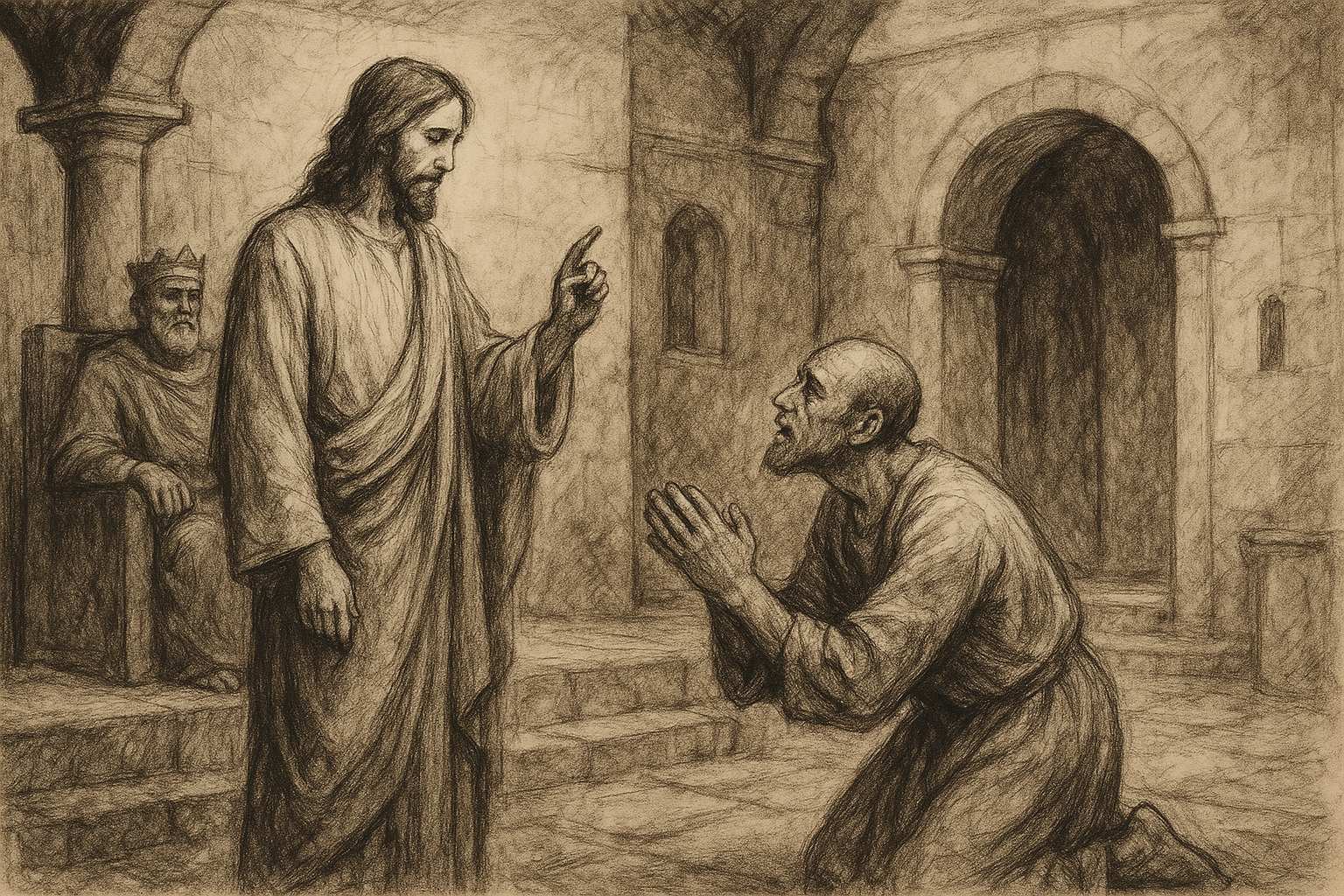
Then Jesus tells a story that is meant to disturb any easy confidence in our own righteousness. A king forgives a servant an enormous debt, one so great that the servant could never repay it. Yet that same servant then seizes a fellow servant by the throat over a much smaller debt and refuses mercy. When the king learns of it, the first servant is judged harshly. Jesus ends with a warning that cannot be softened: so also my heavenly Father will do to every one of you, if you do not forgive your brother from your heart Matthew 18:35.
For Catholics, the the unforgiving servant Catholic meaning is not simply that we should be nicer to others. It is that mercy received from God must become mercy extended to others. The parable cuts to the heart of Christian life because it shows that forgiveness is not an optional extra, but part of what it means to live under the reign of God.
The setting in Matthew 18
Matthew places this parable after Jesus has taught about the lost sheep and the responsibility to seek out a brother who strays. The chapter is not a random collection of sayings. It is a picture of life in the Church, where weakness, offense, correction, and reconciliation are all part of discipleship.
Peter's question is practical and human. He likely thinks he is being generous when he asks whether seven times is enough. Jesus' answer pushes far beyond calculation. In the Kingdom, forgiveness is not based on a tally sheet. It comes from a heart shaped by God's own mercy.
The servant's first debt is staggering. In the ancient world, a talent was a huge sum. Matthew's vivid exaggeration is part of the point. The debt is not merely large; it is unpayable. Jesus wants us to feel the weight of what it means to owe more than we can ever return. The second debt, by comparison, is tiny. The contrast exposes the moral blindness of the unforgiving servant. He has been shown a mercy he never deserved, yet he cannot bear to show the same mercy to someone else.
Mercy received, mercy withheld
The king's response in the parable is severe because the servant's behavior is absurdly out of proportion to what he had received. The servant had begged for patience, and the king had gone beyond patience to full release. But once the servant is out in the street, he forgets everything that was done for him.
This is where the parable becomes painfully close to real life. We may pray for forgiveness, receive it, and even speak often about God's mercy. Yet in daily life we can still cling to injuries, replay offenses, and demand payment from others in ways that reveal how little mercy has reached the depths of our own hearts.
Jesus is not denying the reality of harm. Christianity does not ask the wounded to pretend that wounds are not real. Rather, He shows that unforgiveness becomes a prison. It locks us inside the very debt we fear. The servant in the story is not free after receiving forgiveness. He remains trapped by the logic of account keeping, and so he loses the generosity that had been offered to him.
Mercy is not the denial of justice. It is the decision to place justice in God's hands while refusing to let resentment rule the heart.
What Catholics hear in the parable
Catholic tradition reads this passage in light of the whole life of the Church. We are baptized into Christ, who forgives from the cross, and we are nourished by the sacraments that continually restore us to grace. The Church does not teach that forgiveness is easy. She teaches that it is possible because God first acts upon us.
The sacrament of Penance is especially important here. Every confession is a fresh encounter with divine mercy. We come with debts we cannot repay, and the Lord absolves us not because we have earned it, but because Christ has opened the way. That gift creates a moral obligation. The one who has been forgiven must become a forgiving person.
This does not mean we always feel ready to forgive at once. Sometimes forgiveness is a process. The memory of injury may remain, and prudence may still require boundaries. But the Christian cannot nourish hatred as a way of life. We are forbidden to make vengeance into a private devotion. Instead, we are called to pray for the grace to will the good of those who have harmed us, even when trust must be rebuilt slowly or not at all.
The Catechism speaks plainly about this connection between God's mercy and our forgiveness of others. The Lord's Prayer places it before us every day: forgive us our trespasses, as we forgive those who trespass against us. That petition is not decorative. It is a spiritual test. We ask to be treated as we treat others.
The parable and the interior life
One reason this parable remains so powerful is that it exposes the interior habits of the heart. Outwardly, the unforgiving servant may have looked like any other person who had survived a crisis. But inwardly, he had not let mercy change him.
That is a warning for every believer. It is possible to appear devout while remaining hard. It is possible to attend Mass, say prayers, and still nurse grudges with great energy. Jesus' warning reaches beyond visible behavior to the hidden interior from which our choices come.
Forgiveness begins when we remember the scale of our own dependence on God. Every sin is more than a social mistake. It is a rupture of communion that only divine mercy can heal. When we grasp this, we begin to see others differently. Their offenses may still hurt, but they no longer look like the final word. We have been carried by mercy farther than our anger can travel.
There is also a discipline involved. The Church has always understood that the spiritual life is trained through habits. We learn to forgive by praying for those who wrong us, by refusing to indulge revenge in speech, by going to confession honestly, and by asking God to soften the places in us that remain rigid. The heart does not become merciful by accident.
Forgiveness does not erase truth
It is important to say what this parable does not mean. Jesus does not teach that sin does not matter. He does not tell victims to minimize abuse, or to place themselves back into danger without discernment. Forgiveness is not the same as pretending that evil was harmless.
Rather, forgiveness means that we refuse to become what wounded us. We seek truth without cruelty. We seek justice without revenge. We entrust final judgment to God, who sees perfectly and judges without error. In some cases, forgiveness may include reconciliation. In other cases, reconciliation may not be possible because the other person remains unrepentant or unsafe. But even then, the Christian is still called to renounce hatred and pray for conversion, healing, and peace.
The unforgiving servant refuses precisely this movement from mercy to mercy. He takes the gift but rejects the shape of the giver. He receives compassion from the king but does not allow compassion to form his own conduct. That is why the parable is not only about manners. It is about spiritual truth.
Living the parable today
Catholics can live this teaching in ordinary and very concrete ways. The first step is often to ask where resentment has taken root. Is there a family conflict that has hardened over time? Is there a colleague, neighbor, or fellow parishioner whom we quietly condemn? Have we been reliving an offense until it has become part of our identity?
From there, we can begin with prayer. A simple, honest prayer is enough: Lord, I do not yet know how to forgive, but I want to want what You want. That kind of prayer matters because it turns the heart toward grace. It admits weakness instead of hiding it.
Practical acts can also help:
- pray for the person who hurt you, even if the prayer feels difficult at first
- bring the wound to confession and ask for healing, not just absolution
- refuse to repeat gossip that keeps the offense alive
- ask a trusted priest or spiritual director for guidance if the injury is deep
- remember your own need for mercy before God
None of these steps can force instant emotional peace. But they do make room for grace. And grace is exactly what the parable is about.
The warning and the hope
Jesus' warning is serious because He loves us too much to leave us unchanged. The king in the parable does not shrug at the servant's cruelty. He takes the matter with complete seriousness. That should sober us, but it should not lead us to despair.
The same Christ who tells this parable is the one who, from the cross, prays, Father, forgive them. He does not merely command mercy from a distance. He reveals it in His own flesh. The Christian is never asked to forgive on the basis of personal virtue alone. We forgive because we have first been forgiven in Christ, and because His life within us makes a new way possible.
That is the heart of the the unforgiving servant Catholic meaning. We are not saved by keeping score. We are saved by mercy, and mercy creates a people who know how to release debts, surrender vengeance, and seek reconciliation whenever it is possible. Jesus does not tell this parable to humiliate us. He tells it to free us from the terrible burden of a heart that cannot let go. When we finally begin to forgive, we discover that mercy is not loss. It is the shape of life in the Kingdom of God.
Keep Reading on Lets Read The Bible
Frequently Asked Questions
What is the main lesson of the Unforgiving Servant parable?
The main lesson is that those who receive great mercy from God must extend mercy to others. Jesus warns that unforgiveness is spiritually dangerous because it rejects the gift we ourselves have received.
Does forgiveness in this parable mean Christians must ignore justice?
No. Catholic teaching does not confuse forgiveness with denial of wrongdoing. Forgiveness means refusing vengeance and entrusting judgment to God, while justice, prudence, and safety still matter.
How can Catholics practice the lesson of the Unforgiving Servant?
Catholics can practice it through prayer, confession, mercy toward offenders, honest self examination, and a willingness to ask God to heal resentment over time.